
The fastest way to grow bookings is not signing up for every vacation rental listing site you can find. It’s pairing a small, targeted set of owner-facing directories with reliable two-way sync and, once you’re ready, a direct booking site of your own. Get your master listing right first, verify integrations before you expand, and treat every new channel as a 60 to 90 day test, not a permanent commitment.
TL;DR:
- Listing on two or three carefully selected owner-facing channels with API-based two-way sync typically outperforms spreading across many sites with less reliable updates.
- A strong master listing focusing on search optimization, complete amenities, and high-quality photos should be adapted to each platform, not recreated from scratch.
- Real-time, API-based sync prevents double bookings and is essential once managing more than a few properties or spending significant staff time on calendar updates.
- Test new channels over 60 to 90 days with consistent pricing to accurately measure inquiry-to-booking rates, net revenue, and staff hours, rather than relying solely on visitor counts.
- A direct booking site becomes financially advantageous after your listings are optimized and inquiries are steady, with conversions typically between 3 to 5 percent after a year of marketing.
Table of Contents
- What Are Vacation Rental Listing Sites, and Which Type Fits Your Property?
- How Do You Decide Which Sites to List Your Rental On?
- Build One Master Listing, Then Adapt It Everywhere
- Preventing Double Bookings: What Your Tech Stack Actually Needs
- Comparing Net Revenue, Not Just Listing Fees
- Building a Direct Booking Site to Complement Your Listings
- Security and Fraud Prevention When Listing Your Rental
- Legal and Regulatory Considerations Before You List
- How to Improve Guest Communication Across Every Platform
- A Local Marketplace’s Take on Listing and Optimization
- List Your Property with Gulf Shores Vacation Rentals
- Sources
- FAQ
What Are Vacation Rental Listing Sites, and Which Type Fits Your Property?
Vacation rental listing sites are the platforms where you, as the owner or manager, post your property to attract guest inquiries. That’s distinct from traveler-facing marketplaces where guests browse and book. Owner-facing listing sites generally fall into a few categories, and knowing which one you’re dealing with changes how you evaluate it.
- Local directories — city or region-specific sites (think a Gulf Coast lodging guide) that tend to have smaller audiences but higher intent, since visitors are already committed to your destination.
- Regional and niche directories — broader geographic reach or a focus on a property type, like pet-friendly rentals or beachfront condos, that attract guests filtering for something specific.
- Industry and association directories — listings tied to a hospitality or rental association, often carrying more credibility with guests who value vetted properties.
- Owner-focused marketplaces — platforms built specifically so owners and managers can list, manage, and syncs bookings directly, without a middleman marketplace model.
Local and niche directories usually cost less and convert better per visitor, but they will never match the raw traffic of a large marketplace. That trade-off, reach versus qualified interest, is the first decision you need to make, and Phocuswright’s research on U.S. short-term rental hosts frames this correctly: distribution is a strategic decision, not a popularity contest.
How Do You Decide Which Sites to List Your Rental On?
Every additional listing site adds staff hours, calendar risk, and support overhead. Before you add one, run it through this checklist:
- Audience fit. Does the site’s typical visitor match your property? A ski-town cabin doesn’t need a beach-focused directory, no matter how much traffic it claims.
- Integration capability. Confirm the site supports API-based two-way sync, not just iCal, and check whether it connects to the property management system (PMS) you already use.
- Economics. Compare listing fees or commissions against expected inquiry volume and conversion quality, not just visitor counts.
- Onboarding and support. Ask how long setup takes and what support looks like if sync breaks during a busy weekend.
- Test window. Run the channel for 60 to 90 days with pricing and rules held constant elsewhere so you can isolate its actual performance, a method Phocuswright’s host and property manager research recommends for isolating channel-level results.
Pro Tip: Track staff hours per inquiry during your test window, not just bookings. A site that generates ten inquiries but eats three hours of back-and-forth email per booking is quietly more expensive than one with fewer, cleaner leads.
Promotional tools on some platforms can lift occupancy during shoulder season, but indiscriminate discounting erodes margin faster than it fills calendars, so treat any promotion feature as a targeted tool rather than a default setting.
Build One Master Listing, Then Adapt It Everywhere
Before you touch a single listing site, build one master record you can adapt everywhere else. Trying to write a fresh description for every channel wastes time and produces inconsistent, weaker copy across the board. Owner-facing platforms and industry guidance agree here: VRMA’s listing-improvement guidance stresses search-oriented copy, complete amenity data, and strong photography as the foundation, well ahead of chasing new channels.
Your master listing needs:
- A headline that names the property type, location, and standout feature (e.g., “Gulf-Front Cottage with Private Boardwalk, Sleeps 8”).
- A guest-focused description that leads with the experience, not a room-by-room inventory.
- A complete amenity matrix covering kitchen equipment, parking, accessibility, and pet policies.
- House rules stated plainly, including check-in windows and cancellation terms.
- A photo sequence that opens with the best exterior or view shot, followed by living areas, bedrooms, and bathrooms in that order, shot in landscape orientation at high resolution.
- Structured, machine-readable fields wherever the platform allows them.
That last point matters more than most owners realize. Accurate, machine-readable availability, rate, and inventory data (often called ARI) directly affects how visible your listing is on a given channel, since platforms depend on current data to rank and display properties. Once your master listing is solid, adapt its fields to each site’s specific requirements rather than copying and pasting the same block of text everywhere; a field mapping exercise, not a rewrite, is what a strong multi-channel listing strategy requires.
Preventing Double Bookings: What Your Tech Stack Actually Needs
The single biggest operational risk in multi-channel listing is the double booking, and it almost always traces back to sync method. iCal feeds update on a delay, sometimes hours, which is plenty of time for two guests to book the same dates on two different sites. A true API-driven two-way sync updates availability in real time across every connected channel the moment a reservation is confirmed.
Before adding a channel manager or expanding your channel mix, check for:
- Real-time, API-based two-way sync (not iCal alone).
- Confirmed support for the U.S. channels you actually use.
- Compatibility with your existing PMS or booking software.
- A documented support SLA for sync failures during peak booking periods.
Rentals United’s description of channel manager functionality makes the case plainly: a channel manager exists to synchronize listings, rates, availability, and reservations so you’re not manually updating five calendars every time a booking comes in. If you’re managing more than a handful of properties, or spending several hours a week reconciling calendars by hand, that manual cost usually justifies the switch.
Pro Tip: Ask any channel manager vendor for a real example of an existing integration, not just a feature list. The Lake.com and Lodgify integration is a useful reference point: centralizing listings, calendars, payments, and guest messaging in one connected system cuts duplicate work far more than adding another disconnected listing site ever will.
Comparing Net Revenue, Not Just Listing Fees
A low listing fee means nothing if the channel sends low-intent inquiries that eat your time without converting. Compare channels on net revenue, using the same KPI set across every site you test:
- Inquiry-to-booking rate — what share of inquiries actually convert to a confirmed reservation.
- Average daily rate (ADR) achieved through that channel specifically.
- Cancellation rate, since a site with high cancellations quietly costs you occupied nights.
- Payment processing fees, which vary by platform and can offset a lower commission.
- Staff hours per inquiry, the cost most owners forget to track.
A simple break-even check: take total bookings from a channel over your test window, subtract listing fees, commissions, and payment processing costs, then divide the remainder by hours your team spent managing that channel. If the resulting hourly value is lower than what you’d pay a manager to handle it, the channel isn’t pulling its weight, no matter how cheap the listing fee looked at signup.
Building a Direct Booking Site to Complement Your Listings
A direct booking site becomes worthwhile once your listings are optimized and your operations can support another channel. At minimum, it needs a booking engine with real-time availability, secure payment processing, and schema.org/LodgingBusiness markup so search engines and tools like Google Vacation Rentals can read your property data correctly.
The sequence matters. Optimize your master listing first, distribute it across a targeted set of sites second, and invest in a direct-booking site third, once you have proof of demand and the operational bandwidth to market it. Awning’s guidance on direct-booking strategy notes that professional booking engines typically convert 3 to 5% of visitors, but that volume only shows up after 6 to 12 months of consistent marketing, local SEO, and citation building. A direct site launched without that follow-through will sit quietly with little traffic.
- Real-time availability synced with every other channel you use.
- Secure, PCI-compliant payment processing.
- Structured markup so search engines can display your property correctly.
- A basic local SEO and email retargeting plan to drive return guests, since owned marketing sustains direct bookings far more than the booking engine itself does.
Security and Fraud Prevention When Listing Your Rental
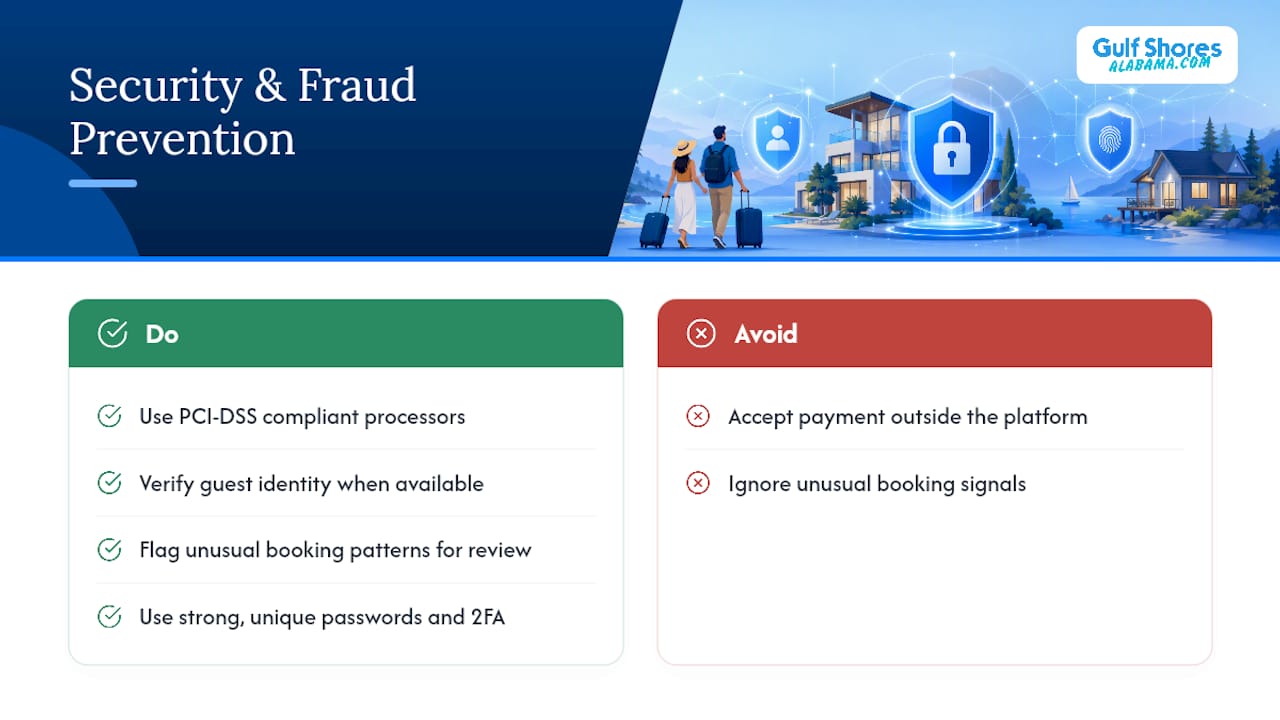
Fraud on vacation rental platforms usually targets one of two points: the payment itself or the guest’s identity. Both are manageable with a few consistent habits.
Never accept payment outside a platform’s secure processing system, even if a “guest” offers to wire funds directly or pay by personal check for a discount. That request is one of the most common fraud patterns in short-term rentals, and it removes any dispute protection the platform would otherwise provide. Stick to processors that are PCI-DSS compliant, whether that’s built into your listing site or your own direct-booking engine.
Verify guest identity where the platform allows it, and treat unusual booking patterns as a signal, not a nuisance. A last-minute booking for an unusually large group, a guest who pushes hard for phone or email communication outside the platform, or a reservation paid with a card that doesn’t match the guest’s stated name all warrant a second look before you confirm.
Protect your own account credentials with strong, unique passwords and two-factor authentication on every listing platform and channel manager you use. A compromised owner account can let someone alter your payout information or lock you out of your own calendar, which is a far bigger operational headache than a single fraudulent booking.
Finally, keep a written record of every guest communication, house rule acknowledgment, and payment confirmation. If a dispute ever escalates, whether over property damage, a cancellation, or a chargeback, that paper trail is what protects you.
Legal and Regulatory Considerations Before You List
Short-term rental regulation in the U.S. is set almost entirely at the city or county level, so what applies in one Gulf Coast town may not apply thirty minutes down the highway. Before listing anywhere, confirm your property complies with local short-term rental permitting, occupancy limits, and any required lodging tax registration in your specific jurisdiction.
Each listing site also carries its own platform-specific rules, covering everything from cancellation policy standards to how you’re allowed to represent pricing and fees. Read those terms before you list, not after a guest disputes a charge, since violating platform policy can get a listing suspended with little warning.
If your property sits in a homeowners association or condo development, check the association’s own short-term rental restrictions separately from city or county law. These two layers of regulation don’t always agree, and an HOA rule can restrict what’s otherwise legal at the municipal level.
When in doubt on a specific legal question, a local attorney familiar with short-term rental ordinances is a better source than a forum thread or a platform’s general FAQ. Regulations shift as more coastal communities and rental associations refine their rules, so building a habit of checking your local ordinance annually costs far less than a fine or a forced delisting.
How to Improve Guest Communication Across Every Platform
Response speed shapes guest impressions before they’ve even seen your property in person. Most listing sites track response time and rate, and guests read a slow reply as a warning sign about how attentive you’ll be once they’ve checked in.
Set expectations early and in writing. A short pre-arrival message covering check-in instructions, parking, and Wi-Fi details cuts down on repetitive questions and gives guests confidence before they arrive. Automating that first message through your PMS or channel manager, where the tool allows it, frees up time for the questions that actually need a personal answer.
Keep your tone consistent across every channel a guest might reach you on, whether that’s a listing site’s messaging system, email, or text. Guests notice when a reply on one platform feels warmer or more detailed than another, and consistency builds the kind of trust that turns into repeat bookings and stronger reviews.
Reviews deserve active attention, not passive hope. Ask satisfied guests directly, ideally right after checkout while the experience is still fresh, since VRMA’s guidance on listing quality treats review cultivation as core maintenance, not an occasional favor to request. A steady stream of recent, detailed reviews does more for conversion than almost any other single listing element you control.
A Local Marketplace’s Take on Listing and Optimization
Gulf Shores Vacation Rentals lists everything from luxury beachfront condos and private beach homes with pools to quiet Gulf-front cottages built for families, couples, snowbirds, and larger groups, which means we see firsthand how differently those property types perform depending on where and how they’re listed. Alabama’s Gulf Coast draws travelers for its beaches, waterfront dining, and sunsets, and a listing that leans into those specifics tends to outperform one written in generic vacation-rental language.
We built out location-specific listings for Orange Beach and Fort Morgan separately from our core Gulf Shores inventory, because guests searching for those areas are looking for something distinct, not just “Alabama beach house.” That’s the same master-listing-then-adapt logic worth applying to your own property: build one strong record, then tailor it to what each audience is actually searching for. Test your channels, track your numbers, and let the data tell you where to expand next.
— Joe
List Your Property with Gulf Shores Vacation Rentals
A local vacation rental marketplace offers direct communication with guests and avoids extra service fees common on larger travel sites, so more of what a guest pays reaches property owners. Instead of competing in a sea of listings on a massive traveler marketplace, your property is listed among selections of rentals in popular Gulf Coast areas, in front of travelers who already know they want this stretch of coast.
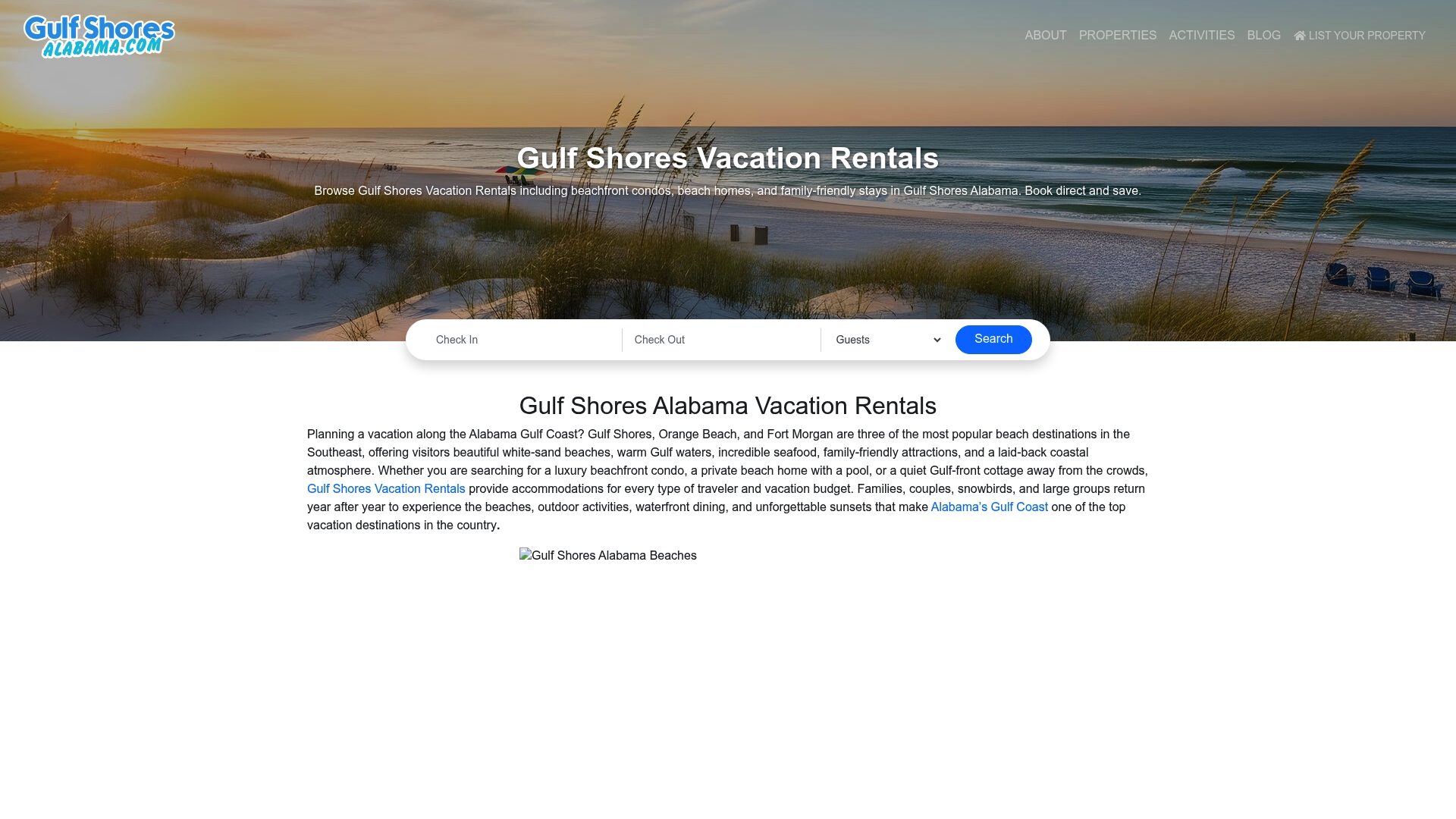
If you’re weighing where to add your beach house, condo, or pet-friendly cottage next, browse how current listings appear on the site to see the format guests respond to before you write your own. When you’re ready, get your property listed directly with Gulf Shores Vacation Rentals and start fielding inquiries from travelers already planning their Gulf Coast trip.
Sources
- U.S. Short-Term Rentals 2025: Host and Property Manager Trends
- Fix my listings: updating your vacation rental before it’s too late
- Rentals United: Vacation rental channel manager
- Vacation rental direct-booking strategy (Awning)
Recommended
- Dynamic Pricing Vacation Rentals: How Hosts Boost Revenue
- Best Airbnb VRBO Alternatives for US Travelers in 2026

About the Author
Joe Godar of the GulfShoresAlabama.com Editorial Team create destination guides, vacation-planning resources, and local travel content focused on Gulf Shores, Orange Beach, and Fort Morgan, Alabama.
Our team researches Alabama Gulf Coast beaches, vacation rental trends, family activities, local attractions, restaurants, events, and direct-booking best practices. Every guide is created to help travelers plan more confidently, discover the best of the Alabama Gulf Coast, and avoid unnecessary third-party guest service fees.
GulfShoresAlabama.com is part of the Emerald Coast by Owner marketing family, connecting travelers directly with verified vacation rental hosts throughout the Gulf Coast since 2016.
This article was reviewed for accuracy and updated using local destination research and current Alabama Gulf Coast vacation rental market insights.