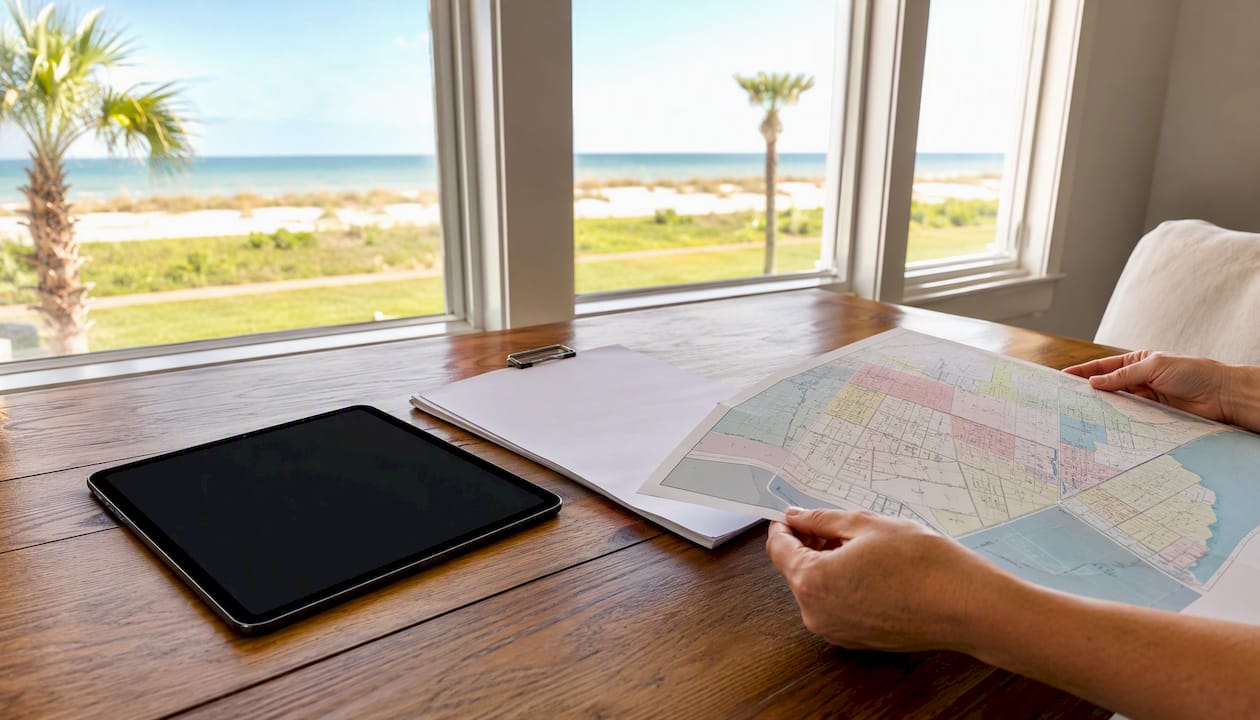
Short-term rentals are legal in Gulf Shores, but only if your unit sits in an approved zoning district and carries a current city Rental License. Before you list a single night on Airbnb or Vrbo, you need to knock out three things: confirm your parcel is zoned for vacation rentals, apply for the annual Rental License through the City of Gulf Shores, and set up lodging-tax registration through My Alabama Taxes, or confirm your booking platform is remitting on your behalf.
Skip any one of those steps and you’re operating outside the city’s ordinance governing Vacation Rental Dwelling Units, which spells out exactly where rentals are allowed, how long a “short-term” stay can run, and what happens when a unit falls out of compliance. The Alabama Department of Revenue also has its own layer of rules on top of the city’s, especially since the state’s accommodations intermediary framework changed how lodging taxes get collected.
Here’s what to handle first:
-
Verify zoning eligibility. Pull up the city’s zoning and overlay map or call Planning & Zoning before you buy, renovate, or list anything.
-
Apply for the Rental License. This is a separate business license specific to short-term rentals, and it must be renewed every year.
-
Register for lodging tax. Set up your account with My Alabama Taxes even if Airbnb or Vrbo already collects tax on your behalf. You’re still on the hook for reconciliation.
More than 44% of a rental unit’s compliance risk in Gulf Shores traces back to skipped or delayed licensing, based on how frequently the city’s own rental license page flags expired or delinquent accounts as the top cause of enforcement action.
Pro Tip: Print the city’s zoning overlay map and keep it with your closing documents. If you’re buying a property specifically to rent it short-term, make zoning verification a contingency in your purchase contract, not an afterthought after closing.
Key Takeaways
Gulf Shores allows short-term rentals only when the unit is zoned correctly, carries a current Rental License, and stays current on state and local lodging tax obligations.
| Point | Details |
|---|---|
| Verify zoning first | Confirm your parcel sits in an approved overlay district before applying for anything. |
| Budget for two fee layers | Expect a gross-receipts business fee plus a $45 per-unit short-term rental charge. |
| Calendar renewal dates | Licenses expire December 31, renew by January 1, and become delinquent after January 31. |
| Don’t assume tax coverage | Reconcile platform-remitted lodging tax against your own records every month. |
| List with local visibility | Gulfshoresalabama connects compliant owners with travelers searching specifically for the Gulf Coast. |
Table of Contents
-
Gulf Shores Rental License: Fees, Deadlines, and Where to Apply
-
Lodging Taxes: What Owners Actually Owe and Who Collects Them
-
List Your Gulf Shores Rental With Support That Understands the Rules
Gulf Shores Rental License: Fees, Deadlines, and Where to Apply
Every property owner renting a unit for less than 180 consecutive days within Gulf Shores city limits or its police jurisdiction needs a Rental License, unless a specific ordinance exemption applies. This isn’t optional paperwork. It’s a separate business license category from a standard commercial license, and the city treats unlicensed short-term rentals as a code violation from day one.
The fee structure has two parts. You’ll pay a gross-receipts-based business license fee calculated under the city’s Fee Schedule A, plus an additional flat charge of $45 per dwelling unit specifically for the short-term rental designation. If you own three condos in the same building, you’re paying that $45 fee three times, once per unit, on top of whatever your gross rental receipts generate under the standard fee tiers.
| Fee component | How it’s calculated | Who pays it |
|---|---|---|
| Gross-receipts business license fee | Based on Fee Schedule A, tied to reported rental income | All licensed rental businesses |
| Short-term rental unit fee | Flat $45 per dwelling unit, per year | Owners of units rented under 180 days |
| Renewal fee | Same structure, billed annually | All license holders renewing by Jan. 1 |
Timing matters more than most first-time owners expect. Rental licenses expire on December 31 every year, renewals are due January 1, and accounts become delinquent after January 31. Miss that window and you’re not just facing a late fee. A lapsed license means you’re technically operating an unlicensed short-term rental, which opens the door to the same enforcement consequences as never having applied at all.
A few things owners consistently get wrong on the fee side:
-
Assuming the $45 fee replaces the gross-receipts fee instead of adding to it.
-
Forgetting that each dwelling unit needs its own license, even in a single building under one owner.
-
Waiting until January to start the renewal, then missing the January 31 delinquency cutoff because of processing delays.
You can apply directly through the Rental License page on gulfshoresal.gov, and the Revenue Division accepts applications in person, by mail, by email, or by fax. If you’re unsure which method fits your timeline, call the Revenue Division directly. Given that renewals cluster around the same January deadline for most owners, phone lines and email queues tend to back up in the final two weeks of the month.
Where Vacation Rentals Are Allowed in Gulf Shores
Not every address in Gulf Shores qualifies for a short-term rental license, and this is where most rejected applications originate. The city allows Vacation Rental Dwelling Units only in specific zoning categories, and applying from a prohibited district wastes both your time and your application fee.
Permitted zones include the Single Family and Duplex Tourist Vacation Rental Overlay District, along with BN, BG, BT, ICW-N, and ICW-S commercial and waterfront designations. Multi-family Planned Unit Developments (PUDs) that are specifically designated for vacation rental use also qualify. If your property sits in one of these districts, you’re clear to move forward with licensing, assuming the rest of the requirements check out.
Prohibited districts tell the opposite story. Agricultural (AG), Airport Transition and Protection (ATP), Educational (ED), Industrial (IND), Open Space (OS), and standard residential zones R-1 through R-5, along with single-family PUD subdivisions, generally can’t host licensed vacation rentals. There’s a real exception here, though, and it matters: nonconforming or grandfathered units that were operating as short-term rentals before the current ordinance took effect can sometimes keep their status, provided the owner meets specific reporting and continuity requirements.
Grandfathering isn’t automatic. Owners need to demonstrate the unit was actively rented short-term before the relevant ordinance cutoff date, and the city expects consistent documentation, not a gap followed by a sudden restart years later. Multi-family nonconforming buildings can sometimes retain eligibility too, but usually only under specific conditions tied to continuous use and prior licensing history.
Pro Tip: Never assume a residential-looking neighborhood is automatically off limits, or automatically approved, just because a similar unit nearby is being rented short-term. Overlay boundaries can split streets or even individual blocks. Call Planning & Zoning and ask for a written determination on your specific parcel before you list.
If you’re still deciding whether to buy, here’s what to check before you make an offer:
-
Pull the parcel’s zoning designation using the city’s interactive zoning map.
-
Ask Planning & Zoning directly whether the address falls inside the Tourist Vacation Rental Overlay District or another approved zone.
-
If the seller claims the unit is grandfathered, request documentation proving continuous short-term rental use, not just a verbal assurance.
Lodging Taxes: What Owners Actually Owe and Who Collects Them
Gulf Shores property owners owe lodging tax at both the state and local level, and since January 1, 2025, a chunk of the collection responsibility has shifted to booking platforms rather than owners themselves. That shift doesn’t mean owners are off the hook. It means the paperwork changed, and reconciliation matters more than ever.
At the state level, Alabama requires lodging providers to register through My Alabama Taxes and remit state lodging tax on short-term stays. Gulf Shores adds its own local lodging tax on top of that state rate, and combined local and state lodging tax obligations in the Gulf Shores area are commonly reported around 16% total, though owners should confirm current rates directly with the Alabama Department of Revenue rather than relying on a fixed figure, since local rate components can shift.
The bigger structural change came from Alabama’s accommodations intermediary rules. Under this framework, platforms like Airbnb and Vrbo that facilitate the booking and collect payment are generally required to collect and remit lodging tax directly for transactions they process, starting January 1, 2025. Alabama law also requires these intermediaries and accommodations providers to file annual reports listing the physical address of any accommodation rented for more than 14 days in the prior year.
Here’s the part owners tend to overlook: even when a platform remits tax on your behalf, you remain the accommodations provider of record. If you self-manage part of your bookings outside a major platform, take direct payments, or use a smaller booking channel that doesn’t automatically remit, you’re responsible for registering and filing directly.
| Tax layer | Who typically remits | Owner action needed |
|---|---|---|
| Alabama state lodging tax | Platform (if intermediary) or owner | Register with My Alabama Taxes regardless |
| Gulf Shores local lodging tax | Platform (if intermediary) or owner | Confirm remittance status per platform |
| Direct or off-platform bookings | Owner | File and remit directly, no exceptions |
Pro Tip: Reconcile your platform-reported revenue against your own booking records every month, not once a year at tax time. Local tax professionals point out that intermediary filings can contain errors, and if a platform underreports your rental income to the state, the shortfall lands on you, not the platform.
How to Apply for a Rental License in Gulf Shores
Applying for a Rental License is a sequential process, and skipping a step usually means your application bounces back for correction rather than moving forward. Here’s the order that works:
-
Complete the business license application form. You’ll need one application per business location, and it must be typed or printed and signed by the property owner or an authorized officer.
-
Attach a copy of your driver’s license. This confirms identity and ties the application to a responsible individual, not just an LLC or business entity name.
-
Include a lease agreement if applicable. This requirement applies specifically to long-term rental arrangements, not short-term vacation rental applications.
-
Confirm zoning eligibility documentation. If your property sits in a grandfathered or nonconforming category, attach whatever proof of continuous prior use you have.
-
Provide emergency contact information. The city requires a local contact, often a property manager, who can respond quickly to guest issues or code complaints.
-
Submit through your preferred method. The City of Gulf Shores accepts applications in person, by mail, by email, or by fax.
Once submitted, your application typically routes through three internal departments: the Revenue Division checks for completeness, Planning & Zoning confirms the parcel’s overlay eligibility, and the Fire Marshal or Building Official schedules the required safety inspection where applicable.
| Document required | Where to get it | Common error that delays approval |
|---|---|---|
| Business license application form | City of Gulf Shores Revenue Division | Left unsigned or submitted typed but unprinted |
| Copy of driver’s license | Personal record | Expired ID or name mismatch with property title |
| Lease agreement (long-term only) | Property owner’s files | Attached unnecessarily for short-term applications |
| Zoning eligibility proof | Planning & Zoning or interactive map | Missing for grandfathered/nonconforming claims |
| Emergency contact information form | City of Gulf Shores | Left blank or contact info goes stale after submission |
The single most common mistake owners make here isn’t a missing document. It’s applying with an emergency contact who moves, changes phone numbers, or stops being available, then never updating the city. A stale emergency contact can trigger license suspension even for an otherwise fully compliant rental.
Safety Inspections and Insurance Every Owner Should Have
Eligible short-term rental units in Gulf Shores go through a safety inspection roughly every three years as a condition of keeping the license current. Inspectors check smoke detectors, fire extinguishers, stairways, electrical systems, balconies and decks, pool safety features where applicable, foundation condition, and 911 addressing visibility from the street.

The consequences for what inspectors find split into two categories, and the difference matters a lot. Immediately hazardous violations, things like exposed wiring, structurally unsound decking, or missing smoke detectors, can trigger license suspension and force you to vacate the unit until the issue is corrected. Non-hazardous violations, on the other hand, typically come with a 21-day cure period, giving you time to fix the problem without losing your license outright.
Roughly a third of first-time rental license applications in coastal Alabama markets face some kind of inspection-related delay, often tied to overlooked deck or electrical issues that owners assumed were fine because the property “looked new.” Budget time for a pre-inspection walkthrough before your official visit, especially on older units.
On the insurance side, a standard homeowner’s policy usually does not cover short-term rental activity. Before you list, confirm your policy either already covers short-term rental use or add a specific short-term rental endorsement. General liability coverage and loss-of-income protection are also worth discussing with your insurance agent, particularly if your rental income makes up a meaningful share of your household budget.
Pro Tip: Keep every inspection report and proof-of-compliance document in the same file as your Rental License paperwork. When renewal time comes, or if you ever face a code complaint, having that history on hand speeds up the response dramatically.
What Occupancy and Rental-Length Rules Actually Mean
Two numbers govern how you can operate a Gulf Shores rental, and confusing them is a common and costly mistake. The 180-day threshold is the zoning cutoff: a rental agreement longer than 180 consecutive days is treated as a long-term tenancy and falls outside the Vacation Rental Overlay rules entirely. The 30-day threshold is different. It governs occupancy, not classification, and the ordinance specifically prohibits one family occupying a licensed vacation rental unit for more than 30 consecutive days.
That distinction trips up a lot of owners who assume a single long booking automatically converts their unit into a long-term rental. It doesn’t. If a guest books your unit for 45 days straight, you may be looking at a compliance issue even though you’re nowhere near the 180-day zoning cap, because you’ve crossed the 30-day family-occupancy limit tied to the vacation rental license itself.
Beyond occupancy, owners typically need to enforce a handful of operational rules that come bundled with the license, even when they’re not spelled out unit by unit:
-
Post clear parking instructions, since overflow parking complaints are one of the most common neighbor-driven code complaints.
-
Set quiet hours and post them inside the unit, particularly for properties near residential zoning boundaries.
-
Provide clear trash and recycling pickup instructions so guests aren’t leaving bags out on the wrong day.
-
Post your emergency contact information visibly inside the unit, not just on file with the city.
A simple house rules card works better than a long document nobody reads. Something like: “Quiet hours are 10 PM to 8 AM. Parking is limited to two vehicles in the driveway. Trash pickup is Tuesday and Friday, bins out by 7 AM. For any issues, call [local contact] at [phone number].” Short, specific, and posted where guests will actually see it.
Penalties, Enforcement, and What Happens If You’re Cited
Operating without a valid Rental License or ignoring a code violation carries real financial and operational consequences in Gulf Shores. Reported municipal fines for code violations run around $250 per infraction, and that’s before you factor in the cost of a suspended license or the lost booking revenue while your unit sits vacant during a forced correction period.
The January 31 delinquency cutoff isn’t just a soft deadline. Once your license lapses past that date, you’re operating unlicensed, which puts you in the same enforcement category as an owner who never applied. Unpaid lodging taxes compound the problem further, since state and local tax delinquency can trigger separate penalties on top of any city licensing fines.
Enforcement generally starts with a complaint, either from a neighbor, a guest, or a routine inspection cycle, and routes through the same departments involved in the original application: Revenue Division, Planning & Zoning, and the Fire Marshal or Building Official depending on the nature of the issue. From there, the cure window depends on severity. Non-hazardous violations get 21 days to correct. Hazardous violations can mean an immediate vacate order with no grace period.
If you’re cited for something, don’t wait to see if it goes away. Document your corrective action with photos and receipts, schedule a reinspection promptly, and contact the Revenue Division directly to confirm your license status hasn’t lapsed during the correction process. Keeping a clean paper trail matters if you ever need to contest a citation or demonstrate good-faith compliance.
Pro Tip: If you receive any citation, respond within the first few days rather than waiting until close to the cure deadline. Inspectors and Revenue Division staff tend to be far more flexible with owners who show immediate, documented effort to fix a problem.
Your Pre-Listing Compliance Checklist
Turning all of this into action means working through the requirements in order, not jumping straight to setting up your Airbnb listing before the paperwork is done. Here’s the sequence that keeps owners out of trouble:
-
Check your parcel’s zoning status using the city’s interactive zoning map, or call Planning & Zoning for an address-specific confirmation.
-
Apply for your Rental License, including all required documents: signed application form, driver’s license copy, and emergency contact information.
-
Schedule your safety inspection if your unit falls into a category requiring one, and budget time for any corrective work the inspection turns up.
-
Register for lodging tax through My Alabama Taxes, even if your primary booking platform already remits on your behalf.
-
Post your house rules and emergency contact information inside the unit where guests will see them immediately.
-
Calendar your renewal deadlines: license expiration on December 31, renewal due January 1, and delinquency after January 31.
Beyond the initial setup, a few recurring dates deserve a permanent spot on your calendar. Rental licenses run on the same annual cycle every year. Safety inspections for eligible units repeat roughly every three years. Lodging tax filings depend on whether your platform handles remittance automatically or whether you’re filing directly, so check your specific setup rather than assuming one schedule fits every owner.
For direct contact, reach the Revenue Division through the City of Gulf Shores Rental License page for licensing questions, Planning & Zoning for parcel-specific eligibility, and the Fire Marshal’s office for inspection scheduling.
Pro Tip: Set a recurring monthly calendar reminder to reconcile your platform-reported rental revenue against your own bank records. This single habit catches remittance gaps before they become a tax bill you didn’t see coming.
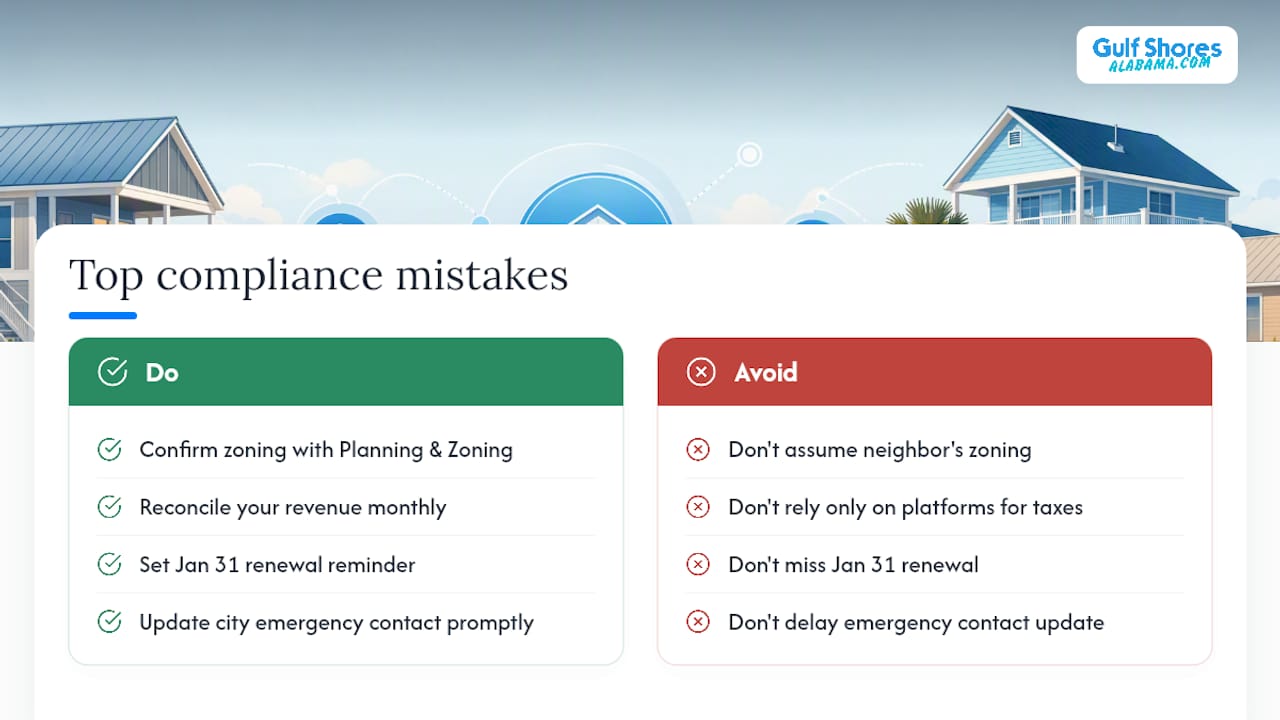
A Local Owner’s Perspective on Common Compliance Mistakes
The mistakes that trip up Gulf Shores rental owners rarely come from ignorance of the rules. They come from assumptions that feel reasonable at the time but turn out to be wrong.
The most expensive one is skipping zoning verification because a similar-looking property nearby is already operating as a short-term rental. Zoning overlays don’t always follow street lines or obvious neighborhood boundaries, and two houses on the same block can fall into entirely different categories. An owner who buys based on a neighbor’s setup, without an independent confirmation from Planning & Zoning, can end up owning a property that will never qualify for a license no matter how well it’s maintained.
The second mistake is treating platform tax remittance as a complete solution. Airbnb and Vrbo handling lodging tax on facilitated bookings feels like it should mean the tax question is settled. It isn’t, particularly for owners who take occasional direct bookings, use multiple platforms with different remittance policies, or manage a mix of short-term and longer stays. The owners who avoid trouble here are the ones who treat their own revenue records as the source of truth and check platform remittance against those records monthly, not the other way around.
The third recurring failure point is the January 31 renewal deadline. It arrives right after the holidays, when most owners are focused on peak booking season rather than paperwork, and it’s an easy date to lose track of. A single missed renewal window can mean weeks of lost booking revenue while a license gets reinstated, on top of the delinquency itself.
A pattern that comes up often: an owner’s emergency contact changes phone numbers or moves out of the area, and nobody updates the city. Months later, a guest complaint comes in, the city can’t reach anyone, and the license gets flagged for suspension over something that had nothing to do with the property itself. The fix is almost embarrassingly simple. Set a reminder every time your property manager or local contact changes, and update the city’s records the same week, not “eventually.”
None of these mistakes require bad intentions or negligence. They’re the natural result of running a rental business where the compliance calendar competes with actually managing bookings, guests, and maintenance. The owners who stay ahead of it treat licensing and tax reconciliation as recurring operational tasks, not one-time boxes to check at purchase.
List Your Gulf Shores Rental With Support That Understands the Rules
Handling zoning checks, license renewals, and tax reconciliation is a real job on top of actually running a rental, and Gulfshoresalabama gives owners a direct path to guest bookings without the overhead of building an audience from scratch. Instead of competing for visibility on a crowded national platform, your property gets placed in front of travelers already searching specifically for Gulf Shores, Orange Beach, and Fort Morgan stays. It connects directly with owners and managers rather than routing everything through a faceless booking algorithm.
To be clear: listing with Gulfshoresalabama doesn’t change your legal responsibilities. You’re still the one who needs the Rental License, the zoning confirmation, and the lodging tax registration covered earlier in this guide. What changes is how much easier it becomes to actually fill your calendar once that paperwork is squared away. If you’re managing multiple units or want a hand with the operational side, the Property Management Gulf Shores AL owner’s guide covers what local managers typically handle, and resources like Nestoria Estates’ overview of property management for short-term rentals walk through when hiring outside help makes financial sense.
Ready to get your property in front of the right travelers? List your Gulf Shores rental today and start building the kind of booking calendar that makes all that licensing paperwork worth it.
Sources
Before you apply for anything, save these pages. They’re the primary sources that override any secondhand summary, including this one, if a rule ever changes.
This article is general information, not a substitute for advice from a qualified lawyer. Consult a qualified legal professional about your own circumstances before acting on anything here.
Recommended
About the Author
Joe Godar of the GulfShoresAlabama.com Editorial Team creates destination guides, vacation-planning resources, and local travel content focused on Gulf Shores, Orange Beach, and Fort Morgan, Alabama.
Our team researches Alabama Gulf Coast beaches, vacation rental trends, family activities, local attractions, restaurants, events, and direct-booking best practices. Every guide is created to help travelers plan more confidently, discover the best of the Alabama Gulf Coast, and avoid unnecessary third-party guest service fees.
GulfShoresAlabama.com is part of the Emerald Coast by Owner marketing family, connecting travelers directly with verified vacation rental hosts throughout the Gulf Coast since 2016.
This article was reviewed for accuracy and updated using local destination research and current Alabama Gulf Coast vacation rental market insights.