
For most small, low-risk vacation rentals, a damage waiver is the low-friction choice. For high-value properties, luxury furnishings, or listings that attract bachelor parties and big groups, a refundable security deposit gives you more control when something goes wrong. The right pick usually comes down to three things: how much a worst-case incident could cost you, how much guest friction you’re willing to accept at checkout, and how fast you need access to funds after a claim.
Here’s the quick math behind that verdict:
-
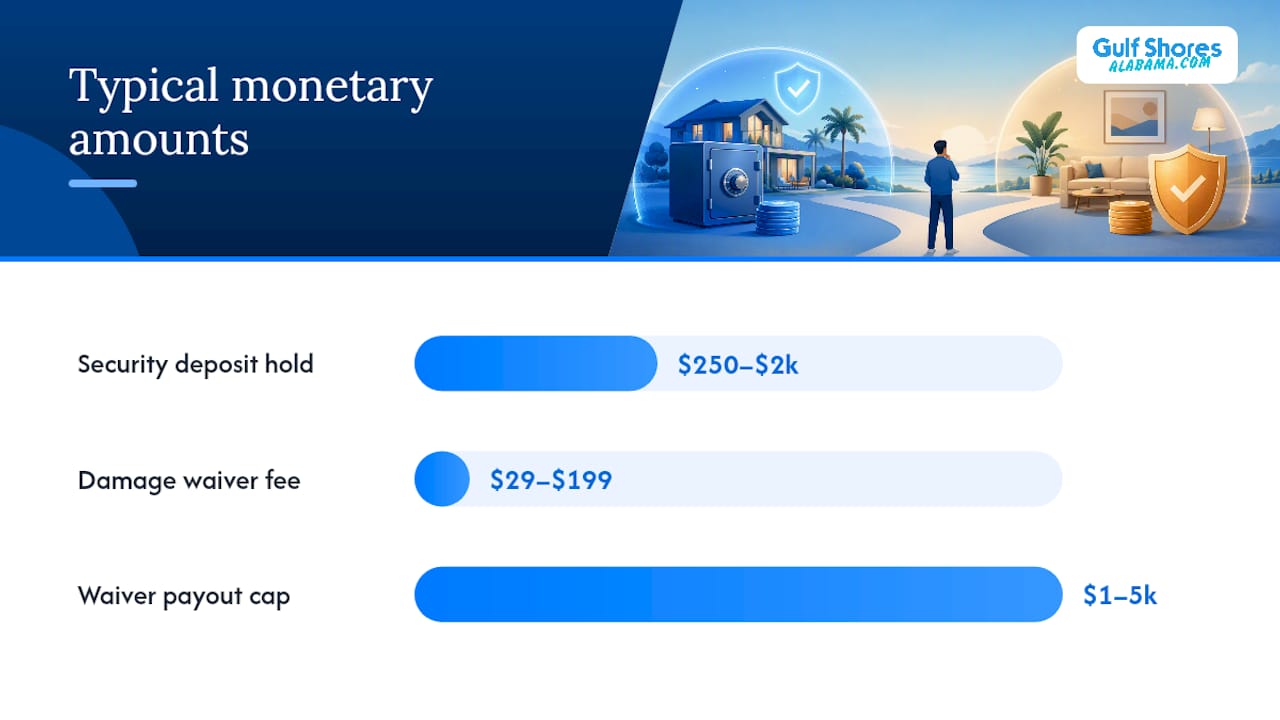
Damage waivers typically run $29 to $199 per stay with coverage caps between $1,000 and $5,000, non-refundable either way.
-
Security deposits usually run $250 to $2,000, refunded in full if the property comes back clean.
-
Waivers reduce booking friction and admin work but exclude intentional damage; deposits give you direct leverage but demand more of your time at checkout.
If your property has a pool, hot tub, boat dock, or a history of large groups, lean toward a deposit or add short-term rental insurance on top. If you manage a portfolio of low-risk condos and want fewer refund disputes, a damage waiver usually wins.
Key Takeaways
The best damage-protection strategy matches the tool to the property’s risk level rather than applying one policy across an entire portfolio.
| Point | Details |
|---|---|
| Match tool to risk | Use damage waivers for low-risk units and deposits for high-value or party-prone properties. |
| Price with a formula | Set deposits at 1× to 3× nightly rate; price waivers between $29 and $199 depending on coverage cap. |
| Document everything | Take timestamped photos at check-in and checkout to support any claim decision. |
| Combine when needed | Pair a small waiver with insurance or a deposit for properties with pools, hot tubs, or big-group risk. |
| Post the policy clearly | Place deposit or waiver terms on the listing page and in the booking confirmation, not buried in house rules. |
Table of Contents
Security Deposit vs Damage Waiver: What a Deposit Actually Is
A security deposit is a refundable amount you hold against damage, missing items, excessive cleaning, or rule violations. If the guest leaves the property in the condition they found it, you release the full amount back. If not, you deduct repair or replacement costs and return the balance, ideally with documentation that would survive a dispute.
Hosts collect deposits two main ways. A pre-authorization hold places a temporary block on the guest’s card without actually charging it. The funds sit reserved, and you release the hold after inspection, usually within 24 to 72 hours of checkout. A captured-and-refunded deposit actually charges the guest’s card at booking, then you process a real refund transaction afterward. Pre-auth holds are faster for guests and cleaner for your books, but they depend on your payment processor supporting authorization holds long enough to cover a multi-day stay.
Pricing follows a simple rule of thumb: charge roughly 1× your nightly rate for lower-risk listings, scaling up to 3× for higher-risk properties with pools, hot tubs, or a history of large groups. Typical short-term rental deposits land in the $250 to $2,000 range, though local regulations and platform policy can narrow that band. Before you settle on a number, check your state and local rules, since some jurisdictions cap how much you can collect and how fast you must return it.
Not every platform handles deposits the same way. Some direct-booking software lets you set custom pre-auth amounts and release windows. Others restrict deposits entirely and push hosts toward their own protection programs instead, which matters if you list across multiple channels.
Pro Tip: Take timestamped photos of every room, closet, and outdoor space before check-in and immediately after checkout. A simple move-in checklist that the guest can review on request turns a “he said, she said” dispute into a documented, defensible claim.
Security Deposit vs Damage Waiver: What a Waiver Covers
A damage waiver is a non-refundable fee, charged to every guest regardless of what happens during the stay, that functions like limited insurance for accidental damage. Instead of holding a deposit and returning it later, you collect a small flat fee upfront and use it to cover repair costs if something breaks, up to a set limit.

Typical damage waiver fees range from $29 to $199, with some hosts pricing them lower, around $20 to $100, depending on property value and platform. Coverage limits commonly sit between $1,000 and $5,000, though some products cap out closer to $3,000. The guest pays this fee no matter what. It is never refunded, even if they leave the property spotless.
Claims under a waiver usually require the guest to report the damage themselves, often within a specific window after checkout. Waivers typically exclude intentional damage, theft, and losses above the coverage cap, and payout windows and reporting requirements vary by provider. If a guest deliberately trashes a room, that claim likely falls outside standard waiver coverage and back into your hands.
Waivers tend to reduce friction at booking because guests don’t have to worry about a hold on their card or a refund process after the fact. That predictability improves booking conversion and cuts down on refund disputes, which is part of why waivers are popular with hosts running larger portfolios across several platforms.
Pro Tip: List the waiver as a built-in line item rather than an upsell. Guests respond better to “Damage protection: $59 (included)” than to a checkbox that feels like an optional add-on they might be tricked into skipping.
How Do a Security Deposit and Damage Waiver Compare?
Security deposits and damage waivers solve the same problem from opposite directions: one holds the guest’s own money, the other spreads a small cost across every booking. Here’s how the two stack up across the factors that matter most to hosts.
| Factor | Security deposit | Damage waiver |
|---|---|---|
| Refundability / who holds funds | Refundable; host holds funds until inspection clears | Non-refundable; guest pays regardless of outcome |
| Coverage scope | Covers whatever the host documents, no fixed cap | Capped, typically $1,000–$5,000, excludes intentional acts |
| Cost to guest | $250–$2,000 upfront hold, returned later | $29–$199 flat fee, gone for good |
| Guest experience / conversion | Adds friction; some guests skip bookings with large holds | Improves conversion and reduces checkout disputes |
| Admin burden | Higher; requires inspection, deduction, and refund process | Lower; provider or host handles capped payout |
| Enforceability / timeline | Direct host control but slower dispute resolution | Faster payout, but limited to covered categories |
| When insurance fits better | Catastrophic loss, liability, or bodily injury claims | Same, plus large-scale property damage beyond the cap |
A quick example makes the tradeoff concrete. A guest who spills wine on a rug is a waiver’s ideal use case: small claim, fast resolution, no drama. A guest who throws an unauthorized party and damages multiple rooms often blows past a waiver’s cap, and that’s where a deposit or an insurance policy earns its keep.
How to Choose Between a Deposit and a Waiver
Start with a risk assessment, not a preference. Walk through these questions for each property you manage:
-
Is the property high-value, recently renovated, or furnished with expensive fixtures?
-
Does it have amenities, like pools, hot tubs, or large common spaces, that tend to attract bigger groups?
-
Does your guest mix skew toward families and couples, or toward larger groups and short weekend bookings?
-
Do you rent seasonally with spikes in demand around holidays or spring break, when party risk climbs?
Once you know your risk profile, implementing either option follows a similar workflow:
-
Set your fee or deposit amount based on nightly rate and property risk tier.
-
Write the policy into your listing description and booking confirmation, not just buried in house rules.
-
Configure platform settings, or your payment processor, for pre-authorization holds or waiver collection at checkout.
-
Run a check-in and check-out inspection routine, ideally with photos logged the same day.
-
Set a clear claim timeline, communicated to guests before they book, not after something breaks.
Before signing with any third-party damage-waiver provider, ask about payout speed, what documentation they require for a claim, and whether their exclusions match your property’s actual risk (pools and hot tubs often carry separate exclusions). If a provider’s cap feels low relative to your furnishings, or its exclusions cover too much of what you’d realistically claim, that’s a signal to keep a retained deposit or add short-term rental insurance instead.
Pro Tip: Run both systems if your portfolio is mixed. Many professional managers use a small damage waiver for routine incidents and a larger deposit or insurance policy for higher-value units, rather than forcing one policy across every listing.
Do You Need Insurance Too?
Deposits and waivers both max out somewhere, and that’s where short-term rental insurance and platform protections pick up the slack. Insurance generally covers liability, bodily injury, and catastrophic property loss, categories that a capped waiver simply isn’t built to handle, though it usually takes longer to process a claim than a waiver payout.
Platform host protection programs (offered by major booking platforms) can list high nominal coverage limits on paper, but claim windows are often short and the platform controls the outcome, not you. Treat platform protection as a backup layer, not your primary plan.
Third-party damage protection services function more like the waivers discussed earlier: automated collection at booking, defined coverage caps, and often longer reporting windows than a platform’s built-in program. The tradeoff is the same one you’re weighing everywhere else in this decision. Broader coverage costs more or takes longer to pay out; narrower coverage is fast and cheap but leaves gaps.
Pro Tip: Escalate to an insurance claim the moment estimated damage approaches your waiver or deposit cap. Filing early preserves documentation and timestamps, both of which insurers weigh heavily during review.
Sample Policy Language You Can Copy Today
A defensible policy is short, specific, and visible before the guest ever checks in. Two templates cover most cases.
Refundable deposit template: “A refundable security deposit of $[amount] will be authorized on your card at check-in. Funds are released within [X] business days of checkout if no damage, missing items, or excessive cleaning is found during inspection.”
Damage waiver template: “A non-refundable damage waiver fee of $[amount] is included in your total and covers accidental damage up to $[cap]. This fee does not cover intentional damage, theft, or losses beyond the coverage limit.”
For claim communication, keep messages factual and specific:
-
Notify the guest within 24 to 48 hours of checkout with photos and a specific cost estimate.
-
Reference the exact policy language they agreed to at booking.
-
State the deduction or claim amount and the remaining refund, if any, with a clear timeline.
Your photo checklist should cover: entry condition of every room, furniture and appliance close-ups, outdoor spaces and amenities, and a final walkthrough video if possible, all timestamped through your phone or booking software. Place your policy on the property listing page itself, not just in a house-rules PDF guests skim past, and repeat the key terms in your booking confirmation email.
A Host’s Take on Making the Switch
A friend who manages three Gulf Coast condos switched two of them to damage waivers after growing tired of chasing deposit refunds every weekend. Claims dropped in complexity, but she kept a retained deposit on her third unit, a larger home with a private pool, after a guest’s late-night party led to a repair bill well past any waiver’s cap. Test a waiver on your lowest-risk listings first, and keep a deposit or insurance on anything with a pool, hot tub, or a track record of big groups.
Sources
Recommended
About the Author
Joe Godar of the GulfShoresAlabama.com Editorial Team creates destination guides, vacation-planning resources, and local travel content focused on Gulf Shores, Orange Beach, and Fort Morgan, Alabama.
Our team researches Alabama Gulf Coast beaches, vacation rental trends, family activities, local attractions, restaurants, events, and direct-booking best practices. Every guide is created to help travelers plan more confidently, discover the best of the Alabama Gulf Coast, and avoid unnecessary third-party guest service fees.
GulfShoresAlabama.com is part of the Emerald Coast by Owner marketing family, connecting travelers directly with verified vacation rental hosts throughout the Gulf Coast since 2016.
This article was reviewed for accuracy and updated using local destination research and current Alabama Gulf Coast vacation rental market insights.