
Yes, booking a vacation rental directly from the owner or property manager usually lowers your total checkout cost. The savings come from one place: the guest service fee that platforms like Airbnb and VRBO add on top of the nightly rate. Airbnb’s guest fee commonly runs in the mid-teens percentage range of the subtotal, and VRBO’s guest service fee typically falls within a moderate percentage range commonly estimated from around six to twelve percent. On a $2,000 booking, that gap is real money.
Before you finalize any reservation, do two things:
-
Compare full checkout totals, not nightly rates. Add nightly rate + cleaning fee + service fee + taxes + damage deposit to get the true number on both channels.
-
Confirm payment protections. Direct bookings require you to verify the host and use a secure, traceable payment method before you send a dollar.
Key Takeaways
| Point | Details |
|---|---|
| OTA guest fees add up fast | Airbnb guest fees commonly run in the mid-teens; VRBO fees typically fall between 6% and 12% of the subtotal. |
| Direct booking removes that line | No guest service fee appears on a direct booking, but cleaning fees and taxes still apply. |
| OTA protections have real value | Rebooking support, mediated refunds, and fraud screening matter most on high-value or unfamiliar bookings. |
| Safety requires two actions | Always use a credit card through a secure gateway and get a written rental agreement before paying. |
| Gulfshoresalabama | Lists Gulf Shores, Orange Beach, and Fort Morgan properties with no guest service fee and direct host communication. |
Table of Contents
-
What protections do OTAs provide, and what do you give up booking direct?
-
When should you book direct, and when should you use an OTA?
-
What should you do about an unfamiliar charge on your statement?
-
Gulf Shores Vacation Rentals: direct bookings with local support
How do direct vacation rental bookings actually work?
A direct booking is any reservation made through the owner’s or manager’s own channels rather than through a third-party platform. That includes a property’s own website, a local property management company, or a fee-free marketplace where the host communicates with you directly.
Payment flows differently depending on the channel:
-
Owner or manager website: You pay through a booking engine (Stripe, PayPal, or a property management system). The merchant name on your card statement reflects the owner’s business name, not Airbnb or VRBO.
-
Refundable security deposit: Held as a pre-authorization and released after checkout if no damage is reported. A charged deposit is collected upfront and refunded later.
-
Installment schedules: Many direct hosts split payment into a deposit at booking and the balance 30–60 days before arrival.
-
Line items on your statement: Nightly rate, cleaning fee, applicable taxes, and a damage deposit or protection plan. No guest service fee line.
Pro Tip: Save a screenshot of the full price breakdown before you pay. If the merchant name on your statement looks unfamiliar, that screenshot is your fastest way to match the charge to the booking.
What does a real cost comparison look like at checkout?
The table below shows typical fee ranges across booking channels. Figures are sourced from industry data; your actual totals depend on the property and dates.
| Line Item | OTA (Airbnb / VRBO) | Direct Booking |
|---|---|---|
| Nightly rate | Set by host | Same or negotiable |
| Cleaning fee | Charged by host | Charged by host |
| Guest service fee | Mid-teens percentage to 12% of subtotal | None |
| Taxes | Collected by platform | Collected by host or manager |
| Damage deposit | Varies; platform-managed | Varies; host-managed |
| Refund on cancellation | Platform policy governs | Host policy governs |
VRBO always adds a service fee to bookings processed on its platform, and there is no legitimate workaround when booking through VRBO itself. That fee funds payment processing, customer support, and platform guarantees. When you book direct, you skip that line entirely, but you also step outside those guarantees.
A few nuances worth knowing:
-
Cleaning fees are set by the host and appear on both OTA and direct bookings. They do not disappear when you go direct.
-
On partial cancellations, OTA service fees are often retained even when a portion of the nightly rate is refunded.
-
Direct bookings carry real costs for hosts too, including marketing, technology, and payment processing. A well-run direct-booking operation passes those savings to guests; a disorganized one may not.
What protections do OTAs provide, and what do you give up booking direct?
OTA platforms bundle protections that have genuine value, especially on high-cost trips.
What OTAs cover:
-
Rebooking support if a property is unavailable at check-in
-
Mediated refunds when a listing is materially misrepresented
-
Fraud screening on hosts and listings before they appear on the platform
-
A structured dispute pathway before you escalate to a chargeback
Risks you accept when booking direct:
-
No platform mediation if a dispute arises; you negotiate directly with the host
-
Variable cancellation and refund policies with no standardized floor
-
Unfamiliar merchant names on your statement can complicate chargebacks
-
Fraud risk is higher with unverified hosts or payment methods outside a secure gateway
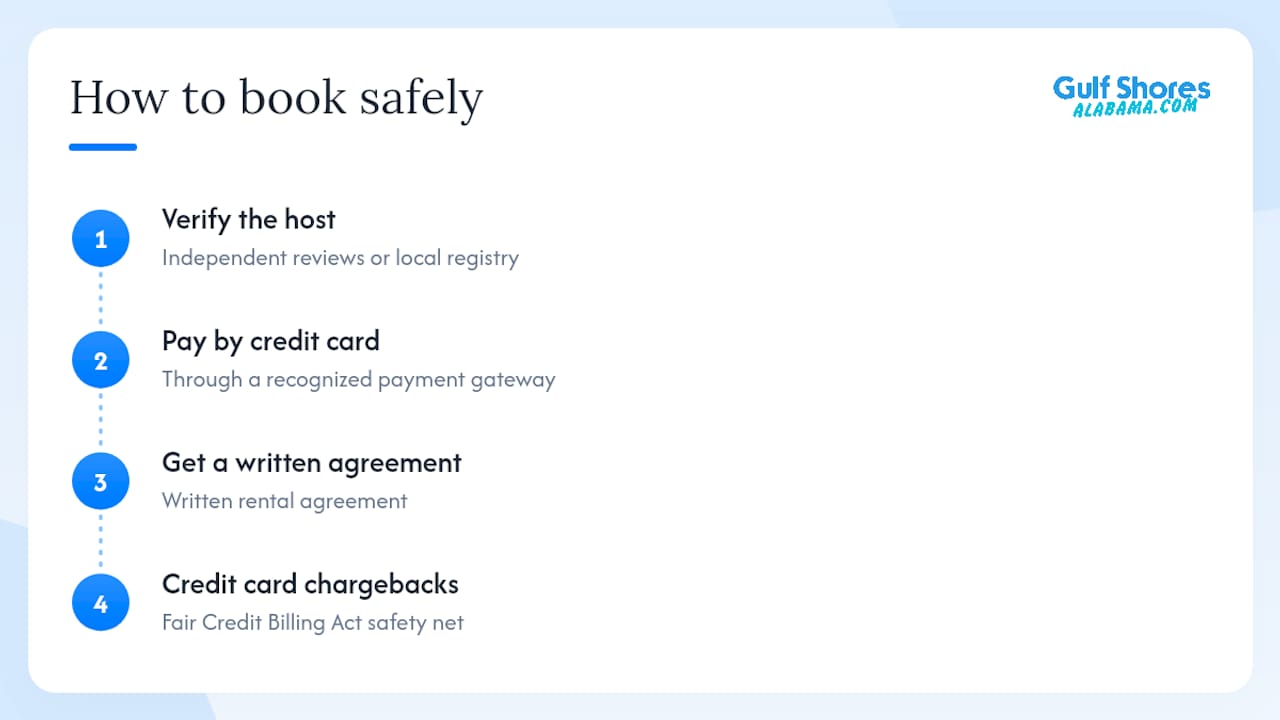
Pro Tip: Pay with a credit card through a recognized payment processor, even on direct bookings. Credit card chargeback rights under the Fair Credit Billing Act give you a meaningful safety net if the property is misrepresented or the host goes dark.
When should you book direct, and when should you use an OTA?
Book direct when:
-
The host or property manager has verifiable reviews, a local business presence, and a secure booking engine
-
Your stay is long enough that the service fee compounds into a significant dollar amount
-
You are a returning guest who already trusts the host
-
You want to negotiate rates, extended-stay discounts, or waived cleaning fees
Use an OTA when:
-
The booking value is high and platform rebooking guarantees matter
-
You are traveling internationally and want a standardized dispute process
-
The host has no independent reviews outside the OTA platform
-
You are booking last-minute and need platform-backed support if something goes wrong
Quick decision checklist:
-
Does the host have verifiable reviews on at least one independent source?
-
Is the total direct checkout price lower after adding all fees?
-
Does the host accept credit card payment through a secure gateway?
-
Is there a written rental agreement with clear cancellation terms?
-
Is the trip value low enough that losing OTA protections is an acceptable tradeoff?
If you answer yes to all five, direct booking is likely the right call.
How to book a vacation rental directly and protect yourself
Follow these steps in order to capture savings without taking on unnecessary risk.
-
Find direct listings. Search the property manager’s own website, local tourism boards, or fee-free marketplaces and direct-booking platforms. Destination-specific sites often list properties with no guest service fee.
-
Verify the host. Search the property address in your county’s short-term rental registry if one exists. Cross-check the host’s name on LinkedIn or a local business directory. Look for reviews on Google Maps or a local property management site.
-
Confirm the payment method. Accept only credit card payments through a recognized booking engine. Traceable payment methods and written rental agreements are the two actions that most reduce fraud risk when booking direct.
-
Request full documentation. Get a written rental agreement, an itemized receipt showing every fee, and the cancellation policy in writing before you pay.
-
Save all communications. Keep every email, text, and booking confirmation. If a dispute arises, your card issuer will ask for documentation.
Pro Tip: Before your stay, send the host a brief email confirming check-in time and property details. A host who responds promptly and specifically is a strong signal that the booking is legitimate.
What should you do about an unfamiliar charge on your statement?
Unexpected charges from vacation rental platforms or hosts are usually explainable, but you need to act quickly.
-
Match the merchant name. Compare the name on your statement to the property name, the host’s business name, and the platform you booked through. OTA charges often appear under a parent company name.
-
Pull your booking confirmation. Check the itemized price breakdown and compare dates and amounts to the charge.
-
Contact the host or platform first. Most issues resolve at this stage. Document the conversation.
-
Escalate to your card issuer if the host or platform does not resolve the dispute within a reasonable timeframe. Credit card chargeback protections apply when a charge is unauthorized or the service was not delivered as described.
-
Report suspected fraud to the FTC at reportfraud.ftc.gov if you believe the listing was fraudulent.
Quick tips for better direct-booking deals
Getting the most out of direct vacation rental bookings comes down to a few habits:
-
Negotiate for long stays. Hosts often waive or reduce cleaning fees for stays of a week or more. Ask politely before booking.
-
Check off-peak pricing. Shoulder-season dates frequently come with lower nightly rates and more flexibility on terms.
-
Watch for hidden costs. A high cleaning fee or a charged (non-refundable) damage deposit can erase the guest-fee savings entirely. Run the full math.
-
Ask about rate matching. If you find a lower total on an OTA, some property managers will match it on a direct booking to avoid paying the platform commission.
Pro Tip: For Gulf Coast stays, choosing the right vacation home involves more than price. Local property managers often include perks like early check-in, beach gear, or local tips that OTA listings rarely mention.
The case for using both channels deliberately
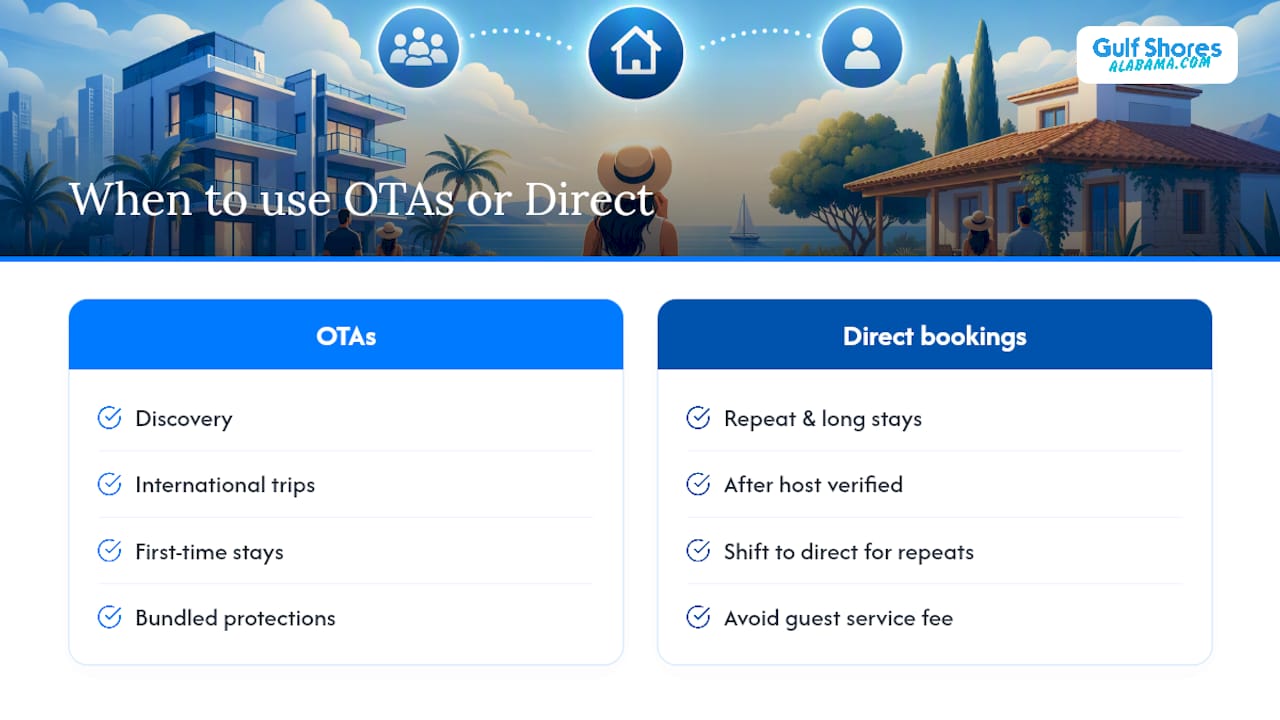
The direct-versus-OTA debate gets framed as a binary, but the smarter approach is situational. OTAs like Airbnb, VRBO, and Booking.com are genuinely useful for discovery, for international trips where platform mediation has real value, and for first-time stays with an unknown host. The protections they bundle are not marketing copy; they matter when something goes wrong.
That said, once you have verified a host and understand the payment flow, the guest service fee is a real cost with no corresponding benefit to you. Paying it repeatedly on familiar properties or long stays is simply leaving money on the table.
The readers who get the best outcomes treat OTAs as a discovery and vetting tool, then shift to direct channels for repeat stays and longer bookings where the fee savings compound. For Gulf Coast travelers, Gulfshoresalabama makes that shift straightforward, with local hosts, transparent pricing, and direct communication built into every listing.
Gulf Shores Vacation Rentals: direct bookings with local support
Skipping the guest service fee is easier when you know exactly who you are booking with. Gulfshoresalabama connects you directly with local property owners and managers across Gulf Shores, Orange Beach, and Fort Morgan, with no guest service fee added at checkout. Every listing shows an itemized price breakdown upfront, payments go through secure processing, and you communicate directly with the host from inquiry to check-out.
Whether you want a beachfront condo with Gulf views, a private pool home for a large group, or a pet-friendly cottage close to the water, the full range of Gulf Shores direct rental listings is available to browse right now. Search by dates, property type, and budget, then contact the owner directly to confirm details and book.
Sources
These sources support the fee data, safety guidance, and cost-comparison analysis in this article:
Recommended
About the Author
Joe Godar of the GulfShoresAlabama.com Editorial Team creates destination guides, vacation-planning resources, and local travel content focused on Gulf Shores, Orange Beach, and Fort Morgan, Alabama.
Our team researches Alabama Gulf Coast beaches, vacation rental trends, family activities, local attractions, restaurants, events, and direct-booking best practices. Every guide is created to help travelers plan more confidently, discover the best of the Alabama Gulf Coast, and avoid unnecessary third-party guest service fees.
GulfShoresAlabama.com is part of the Emerald Coast by Owner marketing family, connecting travelers directly with verified vacation rental hosts throughout the Gulf Coast since 2016.
This article was reviewed for accuracy and updated using local destination research and current Alabama Gulf Coast vacation rental market insights.