
TL;DR: Best Vacation Rental Sites
The best vacation rental site depends on whether you prioritize selection, price, direct communication, or local expertise. Large platforms such as Airbnb and Vrbo offer extensive inventories but may include additional guest service fees. Regional and direct-booking platforms can provide more transparent pricing and direct access to property owners or managers. For Gulf Shores and the Alabama Gulf Coast, travelers should compare the total booking price—not just the nightly rate—while considering cancellation policies, property reviews, amenities, and host responsiveness. Booking directly can often reduce unnecessary fees while giving travelers more direct communication about the property before their stay.
For most travelers, the smartest move is to start with a broad OTA like Airbnb or Vrbo for discovery, then use a local marketplace like Gulf Shores Vacation Rentals for direct Gulf Coast bookings with no guest service fees. For property owners, the right platform mix depends on your inventory type, guest profile, and how much commission drag you can absorb. Major OTAs typically charge hosts a commission per booking, so where you list directly shapes your bottom line.
Here are quick verdicts on the top platforms:
-
Gulf Shores Vacation Rentals — Best local/direct option for Gulf Shores, Orange Beach, and Fort Morgan properties; no guest service fees, direct owner contact.
-
Airbnb — Best for broad discovery, urban stays, unique homes, and last-minute bookings; largest global audience.
-
Vrbo — Best for whole-home family rentals in leisure destinations; guests skew older and book further in advance.
-
Booking.com — Best for international and urban traveler reach; strong in European and Asian markets.
-
Expedia — Best for properties seeking package-travel and corporate exposure via a large distribution network.
-
Plum Guide — Best for luxury properties that pass a strict quality inspection; supports higher nightly rates.
-
Marriott Homes & Villas — Best for premium homes that qualify for Bonvoy loyalty-program demand.
-
Whimstay — Best for filling last-minute gap nights at a discount without manual price cuts.
A practical rule of thumb: optimize one channel to ~75% blended occupancy before adding a second. Adding channels before your primary listing is performing well usually redistributes bookings rather than growing net revenue.
Table of Contents
-
Platform profiles: what you need to know before booking or listing
-
How do you choose the right vacation rental site for your goals?
-
How should property owners build a channel strategy that actually works?
-
Why do local marketplaces and direct bookings matter for your revenue?
What are the best vacation rental sites right now?
| Platform | Best For | Fees & Pricing Model | Inventory / Property Types | Geographic Reach | Host Tools & Controls | Booking Model | Guest Protections |
|---|---|---|---|---|---|---|---|
| Gulf Shores Vacation Rentals | Gulf Coast travelers; owners wanting direct guest contact | Listing fee paid by owner; no guest service fee | Beachfront condos, beach homes, pet-friendly cottages, Gulf-front properties | Gulf Shores, Orange Beach, Fort Morgan, AL | Direct owner-guest messaging; no OTA intermediary | Direct inquiry/booking; owner-managed | Owner-managed; direct communication |
| Airbnb | Urban stays, unique homes, last-minute bookers | Host ~3% (split-fee) or 15.5% (host-only/PMS); guest ~14% | Whole homes, private rooms, shared spaces, unique stays | Global, 7M+ listings | Messaging, calendar, pricing tools, channel manager support | Instant book or request; flexible cancellation tiers | AirCover for guests; host guarantee |
| Vrbo | Whole-home family/group leisure rentals | Host 5% + 3% processing; guest 6–12% | Whole homes only (no shared spaces); condos, cabins, beach houses | Global, 2M+ listings | Calendar sync, payment tools, subscription option | Instant book or request; owner-set policies | Payment protection; support available |
| Booking.com | International/urban travelers; mixed hotel+rental | Host 15–18% commission; usually no guest fee | Hotels, apartments, condos, whole homes | Global; strong in Europe and Asia | Extranet dashboard, channel manager integration | Instant book standard; flexible policies | Booking Guarantee; dispute resolution |
| Expedia | Package/corporate travel exposure | Commission-based; varies by contract | Hotels, condos, vacation homes | Global; strong corporate/package demand | Via Expedia Group channel network | Instant book standard | Expedia traveler guarantee |
| HomeToGo | Aggregated international discovery | Metasearch; fees via connected OTAs | Whole homes, condos, cabins | Global aggregation | Via connected supply partners | Redirects to source platform | Via source platform |
| TripAdvisor | Review-conscious older travelers | Commission or subscription; varies | Vacation rentals, hotels, B&Bs | Global; strong review-research audience | Request or instant book | Review-driven trust signals; dispute via platform | |
| Google Vacation Rentals | Any host wanting organic search discovery | Free organic placement via PMS/OTA integration | All types indexed from connected sources | Global search surface | Via PMS integration; not a staffed inbox | Redirects to source booking page | Via source platform |
| Hotels.com | Hotel-booking audiences via Expedia distribution | Expedia Group commission structure | Hotels, some vacation rentals | Global; Expedia Group network | Via Expedia integration | Instant book standard | Expedia group protections |
| Agoda | Properties targeting Asia-Pacific travelers | Commission-based; varies | Hotels, apartments, vacation rentals | Strong in Asia-Pacific | Via Agoda extranet | Instant book standard | Agoda customer support |
| Plum Guide | Luxury properties passing quality inspection | Commission in the mid- to high-teens percentage range | Vetted luxury homes only | Select global markets | Managed listing process | Request-based; premium policies | Curated vetting; dedicated support |
| Sonder | Branded apartment-style urban stays | Managed program; not self-list | Professionally managed apartments | Targeted urban markets | Brand-managed; not owner-controlled | Instant book; brand-level policies | Brand-level guest support |
| Marriott Homes & Villas | Premium homes; Bonvoy loyalty travelers | Managed program; commission varies | Curated premium homes and villas | Global premium markets | Via professional management | Instant book; brand standards | Marriott Bonvoy protections |
| Getaway | Nature-centered micro-cabin escapes | Managed niche inventory | Micro-cabins, nature retreats | US nature-adjacent locations | Managed; not self-list | Instant book; fixed policies | Brand-managed support |
| Tripping | Aggregated multi-platform search | Metasearch; fees via source OTA | All types aggregated | Global aggregation | Redirects to source platform | Via source platform | Via source platform |
| Homestay.com | Hosted stays, cultural exchange | Commission-based | Private rooms, hosted homes | Global; strong in cultural-exchange markets | Host messaging tools | Request-based | Host-guest review system |
| Fairbnb | Community-benefit, sustainable tourism | Commission; portion to local projects | Whole homes, private rooms | Select European and global markets | Request or instant book | Community-reviewed listings | |
| Onefinestay | Ultra-luxury managed stays | Managed program; premium commission | Curated luxury homes | Select global luxury markets | Managed booking | White-glove managed support | |
| Nofie | Niche traveler segments | Niche/regional model | Niche inventory | Regional; verify before listing | Niche tools | Varies | Varies |
| Vacation Finder | Secondary regional distribution | Listing-based; varies | Vacation homes, condos | Regional US | Basic listing tools | Varies | Varies |
| Whimstay | Last-minute gap-night fill | Discount/managed model | Managed vacation rentals | US-focused | Via connected managers | Last-minute instant book | Via connected manager |
Fee structures and policies change frequently. Always verify current terms directly on each platform before listing or booking.

Fee snapshot: Airbnb’s split-fee model charges hosts roughly 3% and guests around 14%, while the host-only model (mandatory for PMS-connected hosts) charges hosts 15.5% of the booking subtotal. Vrbo’s combined host and processing fees run at a noticeably lower rate than Airbnb’s host-only fee. Booking.com typically charges hosts a commission in the mid-teens percentage range with no separate guest fee. Subscription models on some platforms can be cheaper than per-booking commissions at high occupancy volumes.
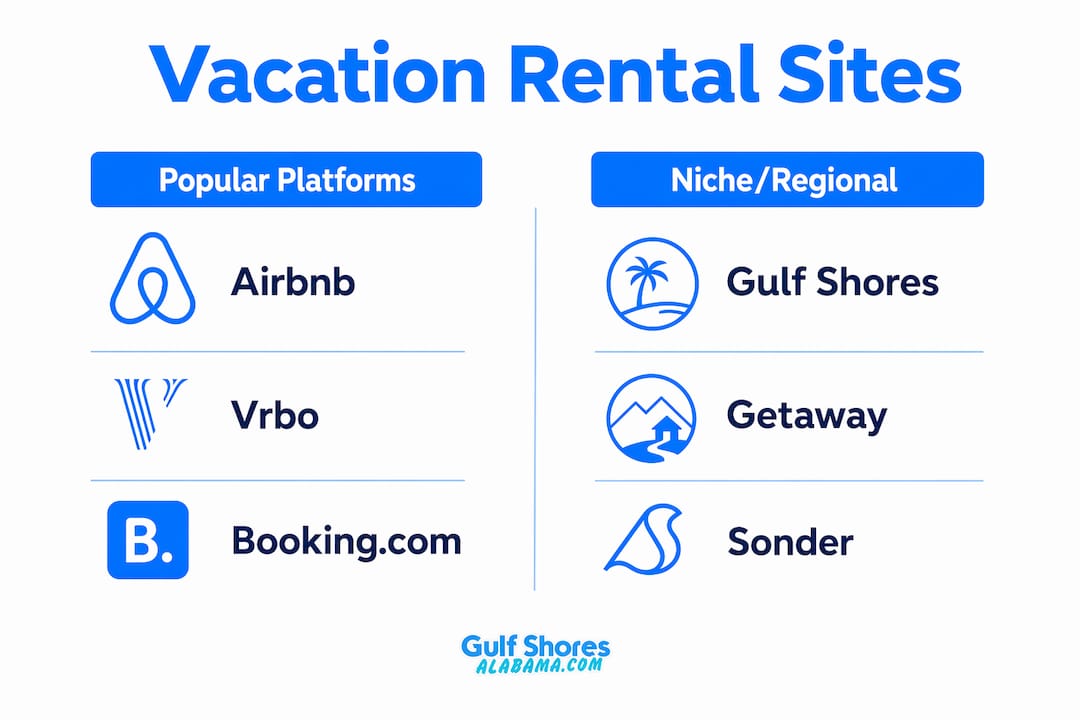
Platform profiles: what you need to know before booking or listing
Gulf Shores Vacation Rentals
Gulfshoresalabama.com is a regional marketplace covering Gulf Shores, Orange Beach, and Fort Morgan, Alabama. Travelers contact owners directly, which means no guest service fee layered on top of the rental rate. For owners, the listing-fee model preserves the guest relationship and keeps repeat-booking economics firmly in your hands.
Best for: Families, couples, and groups planning a Gulf Coast vacation; owners who want direct guest contact and regional visibility.
-
Pros: No guest service fee; direct owner-guest communication; local inventory expertise; pet-friendly and beachfront options well represented.
-
Cons: Coverage is regional (Gulf Coast only); inventory breadth is narrower than global OTAs; ultra-luxury curated villas may be limited.
Pro Tip: Browse Gulf Shores and Orange Beach listings directly to compare beachfront condos and beach homes side by side without the service-fee markup you’d see on a major OTA.
Airbnb
Airbnb is the largest vacation rental marketplace globally, with 7 million-plus listings spanning private rooms, shared spaces, and whole homes. Its audience skews toward millennials and Gen Z, last-minute bookers, and experience-driven travelers. Hosts using a PMS or channel manager are required to use the host-only fee model at 15.5%, so self-managing hosts who stay on the split-fee model pay just 3%.
-
Pros: Unmatched global reach; strong search visibility for new listings; AirCover guest protection builds traveler trust.
-
Cons: Host-only fee at 15.5% is steep for managed properties; algorithm changes can affect visibility overnight; high communication volume.
Vrbo
Vrbo lists whole homes only, no shared spaces or private rooms. Its guest demographic skews older (median age 35–55), more affluent, and family-focused, with average stays of 5–7 nights. That profile means lower damage risk and higher average daily rates for qualifying properties. Vrbo holds roughly 20–25% of the US short-term rental market, making it the clear second channel for most whole-home operators.
-
Pros: Family and group demand; longer stays; lower damage rates; subscription option available.
-
Cons: Whole-home only; lower booking volume than Airbnb; less suited to urban studios or room rentals.
Booking.com
Booking.com blends hotel and vacation rental inventory, which puts your property in front of international and urban travelers that Airbnb and Vrbo under-serve. Host commission runs 15–18%, with no separate guest fee. For properties in tourist destinations, adding Booking.com alongside Airbnb and Vrbo can add meaningful incremental occupancy, particularly from European and Asian travelers.
-
Pros: Strong international reach; no guest-facing service fee; hotel-style distribution network.
-
Cons: Higher host commission; your listing competes directly with hotels in search results; less suited to rural or niche properties.
Expedia
Expedia’s value for vacation rental hosts comes primarily through its distribution network, which includes Hotels.com, Vrbo (also part of Expedia Group), and corporate travel channels. Properties integrated directly into the Expedia Group channel network gain exposure to package and corporate travelers who book flights and accommodations together.
-
Pros: Access to package-travel demand; corporate traveler exposure; wide distribution.
-
Cons: Less direct control over listing presentation; commission structure varies by contract.
HomeToGo
HomeToGo is a metasearch aggregator that pulls listings from multiple OTAs and direct sources. It adds discovery visibility without requiring a separate inbox to manage. Listings appear via connected supply partners, so there is no standalone listing process. Think of it as a free visibility layer on top of your existing channels.
-
Pros: Low-effort extra discovery; strong international aggregation.
-
Cons: No direct booking relationship; traffic quality depends on connected source platforms.
TripAdvisor
TripAdvisor’s vacation rental listings benefit from the platform’s massive review-research audience, particularly travelers aged 35 and older who read reviews before booking anything. The platform offers both commission and subscription pricing. Note that FlipKey, TripAdvisor’s dedicated rental product, was shut down, so verify current listing options directly on TripAdvisor’s site.
-
Pros: Review-driven trust signals; large research audience; established brand.
-
Cons: Smaller dedicated rental audience than Airbnb or Vrbo; fee model details require direct verification.
Google Vacation Rentals
Google Vacation Rentals is a discovery surface, not a staffed channel. Your listings appear in Google travel search results via OTA feeds or certified PMS integration for direct sites. Organic placement costs no commission. If your PMS is integrated, your direct booking site can appear in Google search results alongside OTA listings, capturing high-intent travelers before they ever reach a third-party platform.
-
Pros: Free organic discovery; high-intent search traffic; supports direct booking sites.
-
Cons: Not a standalone channel; requires OTA listing or PMS integration to appear.
Hotels.com
Hotels.com is part of Expedia Group and primarily serves hotel-booking audiences. Vacation rental exposure comes through Expedia Group integration rather than a separate listing process. It is a secondary distribution channel rather than a primary one for most vacation rental operators.
Agoda
Agoda’s strength is its Asia-Pacific demand base. For properties in high-international-tourism markets, Agoda provides access to traveler segments that Airbnb and Vrbo under-index. Commission structure is similar to other OTAs; verify current rates on Agoda’s extranet before listing.
Plum Guide
Every Plum Guide listing undergoes an in-person inspection before approval. The platform’s audience expects and pays for premium quality, and the commission rate is typically in the mid- to high-teens percentage range. If your property genuinely meets the standard, the guest profile is less price-sensitive and more focused on quality. If it does not pass vetting, the application process costs time with no booking upside.
-
Pros: Premium guest profile; supports higher nightly rates; curated audience.
-
Cons: High commission; vetting process is selective; limited geographic coverage.
Sonder
Sonder operates as a branded, professionally managed apartment-style provider in targeted urban markets. It is not a self-listing platform. Owners who meet Sonder’s corporate standards can participate, but the brand controls the listing presentation and guest experience entirely.
Marriott Homes & Villas
Marriott Homes & Villas connects premium properties to Marriott Bonvoy’s loyalty program, one of the largest in hospitality. Access requires professional management and meeting Marriott’s brand standards. For qualifying properties, the loyalty-program demand and premium guest profile can justify the managed-program commission.
Getaway
Getaway is a niche, managed provider focused on micro-cabin nature escapes near major US cities. It is not a self-listing platform. Travelers booking Getaway are specifically seeking a curated, off-grid short escape, not a traditional vacation rental.
Tripping, Homestay.com, Fairbnb, Onefinestay, Nofie, Vacation Finder, and Whimstay
Tripping aggregates listings from multiple platforms, giving hosts additional metasearch visibility with minimal setup. Homestay.com serves hosted stays and cultural-exchange travelers seeking private rooms in local homes. Fairbnb routes a portion of booking fees to local community projects, appealing to travelers and hosts who prioritize sustainable tourism; availability is strongest in select European markets, so verify US coverage before listing. Onefinestay offers white-glove managed luxury home rentals in select global markets. Nofie is a niche platform; confirm regional presence and fee structure directly before committing. Vacation Finder provides secondary regional distribution for US properties and works best as a supplemental channel. Whimstay specializes in last-minute discounted inventory for managed properties, making it a practical tool for filling gap nights without manual price adjustments.
Pro Tip: For any platform with limited public fee information (Nofie, Vacation Finder, Tripping), request a current rate card before listing. Fee structures on smaller platforms can change without broad announcement.
How do you choose the right vacation rental site for your goals?
The right platform depends on what you are trying to accomplish, whether you are searching for a rental or listing one. Work through these questions before committing.
For travelers
-
What is your trip type? Whole-home family vacation → Vrbo or Gulf Shores Vacation Rentals. Urban weekend trip → Airbnb. International travel → Booking.com or Agoda. Nature escape → Getaway.
-
How flexible is your schedule? Last-minute booker → Airbnb or Whimstay. Planning weeks ahead → any major platform.
-
Do you want to avoid guest service fees? Use a local marketplace like Gulfshoresalabama or a host’s direct booking site.
-
Do you value loyalty points? Marriott Homes & Villas integrates with Bonvoy; Expedia has its own rewards program.
-
How important are reviews to your decision? TripAdvisor and Airbnb both surface strong review signals.
For property owners
-
What is your property type? Whole home in a leisure destination → Vrbo is a natural fit alongside Airbnb. Urban apartment → Booking.com adds international demand. Luxury property → evaluate Plum Guide or Marriott Homes & Villas. Gulf Coast property → Gulfshoresalabama for direct regional exposure.
-
What is your target length of stay? Short nightly stays → Airbnb/Vrbo. Monthly or corporate stays → Furnished Finder (not covered in this guide’s primary list but worth noting for 30-plus-day markets).
-
Do you need instant booking? Most major OTAs support it; local marketplaces may use inquiry-based contact.
-
Do you want to own the guest relationship? OTAs restrict direct contact before booking. Local marketplaces and direct booking sites give you guest data from the first inquiry.
-
Can you manage chargebacks and merchant-of-record responsibilities? Direct booking sites shift payment processing to you. Confirm your PMS or payment processor handles disputes before going direct.
Red flags to watch for
-
No two-way calendar sync: a platform without it creates double-booking risk the moment you list on more than one channel.
-
Opaque payout timing: if a platform cannot tell you clearly when funds arrive, that is a cash-flow problem waiting to happen.
-
Poor dispute resolution history: check host forums and review sites before listing on any platform outside the major OTAs.
A clean decision flow: start with one primary OTA, build to ~75% blended occupancy, then add a second channel that fits your inventory type. Whole-home leisure properties add Vrbo as the natural second channel. Urban apartments add Booking.com. Gulf Coast properties add Gulfshoresalabama for direct regional exposure and guest-data retention.
How should property owners build a channel strategy that actually works?
Getting your channel mix right is less about listing everywhere and more about listing smart. Here is a practical framework.

Start with one channel and stabilize it. Fix your listing quality, pricing, and review velocity before adding a second platform. Adding channels without a strong primary listing usually just spreads the same demand thinner across more inboxes, which creates operational overhead without adding net bookings.
Add a second channel when you hit ~75% blended occupancy. That threshold signals your primary channel is performing well and incremental demand from a second platform is likely to be additive rather than redistributive. For a whole-home leisure property, Vrbo is the logical second channel. For an urban apartment, Booking.com adds the international demand Airbnb under-serves.
Operational checklist before going multi-channel:
-
Two-way calendar sync active on all platforms
-
Instant-book settings reviewed and consistent across channels
-
Payment and merchant-of-record setup confirmed
-
Dynamic pricing tool configured (static pricing is the most common missed revenue opportunity)
-
Review velocity strategy in place (prompt post-stay messages, consistent guest experience)
When to invest in a channel manager or PMS. Once you are managing two or more platforms, a channel manager pays for itself in avoided double bookings and saved inbox time. Look for tools that include Google Vacation Rentals integration, two-way calendar sync, and pricing automation compatibility. Google Vacation Rentals can surface your direct site organically when your PMS is integrated, so that connectivity is worth prioritizing.
Pro Tip: Dynamic pricing tools consistently outperform manual pricing, especially during demand spikes. Configure your tool to adjust rates automatically for peak weekends, local events, and last-minute gaps rather than relying on a static rate card.
Direct booking economics. A direct booking site eliminates per-booking commission but introduces fixed costs: processor fees (roughly 2.9% plus $0.30 per transaction via Stripe), hosting or builder fees, and marketing time. The math favors direct booking when your repeat-guest rate is meaningful. A host earning $80,000 annually and converting just 20% of bookings to direct saves roughly $1,920 per year at a 12% commission rate. That figure scales quickly for multi-property operators. Run the break-even calculation against your actual repeat rate before investing in a paid direct-site tool.
Platform fatigue is real. Managing three or more platforms without centralized tools often reduces profitability rather than growing it. If adding a channel increases your inbox volume and calendar complexity without a measurable occupancy lift within 60–90 days, scale back.
How were these sites evaluated?
Sites were assessed across seven criteria: fees and pricing model (host commission, guest fees, subscription vs. per-booking), inventory types supported, geographic reach, host tools and owner controls, booking model and cancellation policies, guest protections and dispute resolution, and overall user experience including mobile app availability. Research was drawn from industry sources and operator data current as of mid-2026.
Limitations: Fee structures are market- and contract-dependent and change frequently. Some platforms (Nofie, Vacation Finder) have limited public documentation. Always verify current terms directly on each provider’s site before listing or booking. This guide is general information; it is not a substitute for reviewing a platform’s current terms of service.
Why do local marketplaces and direct bookings matter for your revenue?
The biggest long-term advantage of a direct or local marketplace channel is guest data ownership. When you book through a major OTA, the platform controls the guest relationship. You receive a booking confirmation but not the guest’s email address or booking history. Direct bookings give hosts access to guest contact details and booking history, a recurring asset that supports higher lifetime value per guest and reduces reliance on OTA algorithms over time.
For Gulf Coast property owners specifically, Gulfshoresalabama operates as a local marketplace where travelers contact owners directly. That means you capture the guest relationship from the first inquiry, not after the third OTA booking. Repeat guests who book directly skip the OTA service fee entirely, which makes the stay cheaper for them and more profitable for you.
Practical tactics for capturing repeat guests without violating OTA policies:
-
Include a welcome card in your property with your direct booking site URL (not a request to rebook outside the current OTA booking).
-
Offer a loyalty discount on your direct site that is publicly available (not a private offer made during an active OTA stay).
-
Integrate your PMS with Google Vacation Rentals so your direct site appears in organic search results alongside OTA listings.
-
Use post-stay email sequences (where you have the guest’s contact details) to share availability and direct-booking rates for future trips.
The strategic frame: OTAs are demand acquisition channels, not permanent homes for your guests. Use them to acquire first-time guests, then convert repeat visitors to direct bookings where the economics are better for both sides.
Pro Tip: The direct booking break-even point arrives faster than most hosts expect once repeat-guest volume builds. Track your repeat-booking percentage quarterly. When it crosses 15–20%, a direct channel investment typically pays for itself within a season.
Key Takeaways
The strongest vacation rental strategy combines a primary OTA for discovery, a secondary channel matched to your inventory type, and a local or direct marketplace for repeat-guest economics and fee savings.
| Point | Details |
|---|---|
| Start with one OTA | Build to ~75% blended occupancy on your primary channel before adding a second platform. |
| Match channel to inventory | Whole-home leisure properties add Vrbo second; urban apartments add Booking.com for international reach. |
| OTA commission drag | Major OTAs charge hosts mid-teens percentage commissions; host-only Airbnb fees run 15.5% for PMS-connected hosts. |
| Direct booking value | Direct channels eliminate per-booking commission but add fixed costs; break-even depends on your repeat-guest rate. |
| Gulfshoresalabama | The recommended local/direct option for Gulf Shores, Orange Beach, and Fort Morgan properties; no guest service fees, direct owner contact. |
The case for thinking beyond the big two
Most vacation rental advice starts and ends with Airbnb versus Vrbo. That framing is useful but incomplete. The platforms that dominate discovery are not the same ones that win on margin, guest loyalty, or fit for every property type.
A beachfront condo in Gulf Shores is not the same product as a Nashville bachelorette house or a furnished apartment near a hospital district. Each attracts a different guest, books at a different lead time, and performs differently on each platform. Treating Airbnb as the universal answer ignores the fact that Vrbo’s guest demographic, older, more affluent, booking further in advance, is often a better fit for Gulf Coast leisure properties. And neither platform gives you what a local marketplace gives you: the guest’s contact information and the ability to build a direct relationship from day one.
The other underrated point is platform risk. Sonder’s collapse after its Marriott deal ended took bookings with it. FlipKey was shut down by TripAdvisor. Any platform that controls your primary booking volume is a single point of failure. A diversified channel mix, anchored by a strong primary OTA and supplemented by a local or direct channel, is not just a revenue strategy. It is a business continuity decision.
Gulf Shores vacation rentals without the service-fee markup
If you are planning a trip to Alabama’s Gulf Coast, or you own a property there, Gulfshoresalabama gives you something the major OTAs do not: direct access to owners with no guest service fee added at checkout. That difference is real money on a week-long beachfront stay.
The marketplace covers Gulf Shores, Orange Beach, and Fort Morgan, with listings ranging from beachfront condos and private beach homes to pet-friendly cottages and budget-friendly options for families and groups. Owners list directly, so you communicate with the person who actually manages the property, not a customer service queue. For property owners, the listing-fee model means you keep the guest relationship and the guest’s contact details from the first inquiry.
A few honest notes: coverage is regional, so if you are searching outside the Gulf Shores area, you will need one of the global OTAs covered above. Ultra-luxury curated villa inventory is more limited here than on platforms like Plum Guide or Onefinestay. But for Gulf Coast stays, the combination of local expertise, direct contact, and no guest service fee is a genuine advantage. Browse available Gulf Shores properties and contact owners directly to check availability for your dates.
Useful sources and further reading
-
STR Websites Explained: How to Pick the Right Platform — MaverickSTR, accessed mid-2026
-
Vacation Rental OTA Distribution Beyond Airbnb — Nightly Data, accessed mid-2026
-
Airbnb Fees vs. Your Own Website: The Real Economics for a US Host — Cavmir, accessed mid-2026
-
Direct Booking Website Math: When Escaping OTA Commission Pays Off — RentTools, accessed mid-2026
-
Best Vacation Rental Sites for Owners (2026) — Cascadia Getaways, accessed mid-2026
-
Airbnb vs Vrbo for Owners: 2026 Fee & Revenue Guide — Awning, accessed mid-2026
Fee schedules and platform policies change. Verify current terms directly on each provider’s site before listing or booking.
Recommended
About the Author
Joe Godar of the GulfShoresAlabama.com Editorial Team creates destination guides, vacation-planning resources, and local travel content focused on Gulf Shores, Orange Beach, and Fort Morgan, Alabama.
Our team researches Alabama Gulf Coast beaches, vacation rental trends, family activities, local attractions, restaurants, events, and direct-booking best practices. Every guide is created to help travelers plan more confidently, discover the best of the Alabama Gulf Coast, and avoid unnecessary third-party guest service fees.
GulfShoresAlabama.com is part of the Emerald Coast by Owner marketing family, connecting travelers directly with verified vacation rental hosts throughout the Gulf Coast since 2016.
This article was reviewed for accuracy and updated using local destination research and current Alabama Gulf Coast vacation rental market insights.