
TL;DR:
- Book direct: Avoid OTA guest service fees by booking with the property owner or manager.
- Compare total prices: Check the complete checkout price—not just the nightly rate.
- Ask for discounts: Longer stays may qualify for reduced rates or cleaning fees.
- Watch hidden costs: Review cleaning, pet, resort, processing, and extra-guest fees.
- Book safely: Use secure payment methods and always get a written rental agreement.
- Gulf Coast tip: GulfShoresAlabama.com connects travelers directly with Gulf Shores-area hosts without marketplace guest service fees.
The fastest way to avoid vacation rental fees is to book directly with the owner or property manager, bypassing the OTA (online travel agency) layer entirely. No guest service fee. No platform markup. Just the base rate, cleaning, and taxes.
Here’s a three-step plan you can use right now:
-
Compare all-in totals first. Pull up the same property on Airbnb or VRBO and let the checkout screen show you the full price, including every fee and tax. Screenshot it.
-
Find the direct channel. Search the property address, check the listing bio for a website link, or use a verified no-fee marketplace like Houfy or Gulfshoresalabama to reach the owner directly.
-
Book or negotiate. Contact the owner with the OTA total as your reference point and ask for a direct rate that beats it.
Pro Tip: Always pay through a secure checkout gateway, never by wire transfer or gift card. Keep your booking confirmation and rental agreement on file.
Key Takeaways
| Point | Details |
|---|---|
| Book direct to eliminate service fees | Guest service fees of 4%–20% disappear when you bypass the OTA and contact the owner directly. |
| Compare all-in checkout totals | Always pull the full OTA checkout price, including cleaning and taxes, before negotiating a direct rate. |
| Negotiate cleaning fees on longer stays | Hosts often reduce or waive cleaning fees for stays of 7+ nights, compounding your per-night savings. |
| Know when the OTA fee is worth it | For high-value or complex trips, platform guarantees can justify a fee of $200–$400 or more. |
| Gulfshoresalabama offers no-fee direct booking | Gulf Shores, Orange Beach, and Fort Morgan listings connect you to owners with no guest service fee added. |
Table of Contents
How do vacation rental fees actually work?
Before you can reduce fees, you need to know where they come from. Most vacation rental platforms layer several charges on top of the nightly base rate.
Common fee types:
-
Guest service fee: A percentage charged to the guest by the platform, typically ranging from roughly 4% to 20% of the reservation subtotal.
-
Host/platform commission: A separate fee the host pays the platform, usually 3%–15% depending on the platform and listing type.
-
Cleaning fee: A flat charge set by the host, often $75–$300 or more for larger properties. On VRBO, this fee is included in the subtotal before the service fee is calculated, which means a high cleaning fee directly inflates the platform charge.
-
Extra-guest and pet fees: Per-person or per-pet nightly charges that stack on top of the base rate.
-
Local lodging/occupancy taxes: Set by city, county, or state, these are non-negotiable and apply regardless of which channel you book through.
-
Payment-processing surcharges: Some direct-booking platforms pass a small credit card processing fee (typically 2%–3%) to guests.
-
Refundable security deposit: Held temporarily and returned after checkout, but it ties up cash during your stay.
Split-fee vs. single-fee models
Platforms handle fees in two ways. The traditional split-fee model charges both the host and the guest separately, making the guest-side fee visible at checkout. The single-fee model shifts the full platform cost to the host, so the guest sees a cleaner price, but the host often builds that cost into the nightly rate to compensate.
Airbnb has moved many hosts toward a host-paid single-fee structure, which changes how totals appear but does not eliminate the underlying platform cost. VRBO uses a sliding-scale guest service fee calculated on the full reservation subtotal, including cleaning fees, so a $200 cleaning fee on a short stay can add $12–$30 to your platform charge alone. Comparing all-in checkout totals across channels is the only reliable way to see what you’re actually paying.
Why booking direct usually saves you money
Every dollar Airbnb or VRBO charges as a guest service fee goes to the platform, not the host. When you book direct, that layer disappears. Industry surveys suggest travelers who book direct save around 10–15% on total accommodation costs, with larger savings on longer or higher-value stays.
The math is straightforward. Book the same property direct, and that $210 stays in your pocket or gets split between you and the host as a mutual incentive.
Hosts have their own reason to welcome direct bookings. Many price their OTA listings higher to cover commissions, which means the OTA rate already includes padding.
The exceptions matter, though. For very expensive group trips, first-time bookings with unknown hosts, or international stays where language and legal recourse are uncertain, the OTA’s dispute resolution and guarantee can be worth the fee. A $200 service charge is cheap insurance against a $2,000 problem. More on that tradeoff in the section below.
Pro Tip: *When a host saves their commission by booking direct, ask them to split the difference with you.
Where to find direct-booking options safely
Finding a direct channel takes a few minutes of research, and the payoff is real. Here’s how to do it without increasing your fraud risk.
Search tactics:
-
Look at the OTA listing bio or “about the host” section for a website link or business name.
-
Copy a unique phrase from the listing description and paste it into Google. The property’s own site or a local manager’s page often appears.
-
Search the property address directly. Many management companies list the same unit on their own site.
-
Use verified no-fee direct marketplaces. Houfy, for example, requires host identity and property verification before listings go live, giving you discovery similar to a major OTA without the guest service fee markup.
-
Browse local property manager sites and tourism association listings for Gulf Shores, Orange Beach, and Fort Morgan. These often link to direct-booking pages.
-
Check the best vacation rental sites guide on Gulfshoresalabama for a curated list of verified platforms and fee-free discovery options.
Safety checklist for direct bookings:
-
Verify the business has a physical address and a working phone number.
-
Read reviews on multiple platforms, not just the one where you found the listing.
-
Pay through a secure checkout gateway (credit card or verified payment processor). Wire transfers, gift cards, and peer-to-peer apps are the primary vectors for rental fraud.
-
Get a written rental agreement and booking confirmation before sending any payment.
-
Confirm cancellation terms in writing.
Pro Tip: When you reach out to an owner or manager after finding them through an OTA, be transparent. Say you’d like to book direct and ask for their official website or secure checkout link. Most legitimate hosts will appreciate the directness and respond promptly.
For a deeper look at digital reservation mechanics and secure payment practices, this guide to digital reservations covers what every traveler should know before sending money online.
How to negotiate fees with owners: scripts you can use
Direct booking gives you negotiating power that OTAs simply don’t. Hosts save on commissions, and that creates room for a deal. The best moments to ask are during long stays, off-peak dates, last-minute gap weeks, or when you’re a returning guest.
What to ask for:
-
A percentage discount on the nightly rate (5%–15% is reasonable for stays of 5+ nights)
-
A waived or reduced cleaning fee for stays of 7+ nights
-
Added value: early check-in, late checkout, or a welcome credit
-
A rate that matches or beats the all-in OTA total
Three copy-and-paste scripts:
-
Long-stay discount request: “Hi [Name], I’m interested in booking [Property] for [dates] — a [X]-night stay. I’d love to book directly with you rather than through [OTA]. Would you be open to a [7–10]% discount on the nightly rate for a direct booking? I’m happy to pay through your secure checkout and sign a rental agreement.”
-
Cleaning fee waiver for a longer stay: “Hello, I’m planning a [7+]-night stay at [Property] and noticed the cleaning fee is [$X]. Since I’ll be staying longer and will tidy up before checkout, would you consider waiving or reducing the cleaning fee for a direct booking? I’m flexible on dates and ready to confirm quickly.”
-
OTA price-match request: “Hi [Name], I found your property on [OTA] with an all-in total of [$X] for [dates]. I’d prefer to book direct to save us both the platform fees. Can you offer a comparable or better rate through your direct booking channel? I’m ready to move forward as soon as we agree on terms.”
Pro Tip: Pull up the OTA checkout screen and note the exact all-in total, including every fee and tax. Sharing that number with the host gives them a concrete target to beat and makes the conversation feel fair rather than adversarial.
Hidden fees to check before you commit
Run through this checklist before you finalize any booking. Each fee type can appear at checkout as a surprise if you don’t look for it first.
-
Cleaning fee: Often listed separately; for short stays it can equal or exceed one night’s rent. Ask if it’s negotiable for longer stays.
-
Admin or processing fee: Some managers charge a flat booking or admin fee on top of the nightly rate. Look for it in the “other fees” line.
-
Extra-guest fee: Many properties charge per person above a base occupancy (often 2–4 guests). Count your group carefully.
-
Pet fee: Usually $50–$150 per pet per stay. Some properties charge nightly. Confirm the exact amount before booking if you’re bringing a pet. For Gulf Shores options, the pet-friendly rentals guide shows properties with transparent pet policies.
-
Resort or HOA fee: Common in condo complexes. Covers amenities like pools and beach access. Sometimes listed separately from the nightly rate.
-
Service or facility fee: A flat charge some managers add for property management overhead. Not the same as the platform service fee.
-
Security deposit or damage hold: Refundable but can be $200–$1,000+. Confirm the release timeline in writing.
-
City/county occupancy tax: Non-negotiable. Ranges from 5%–15% depending on the municipality. Always included in the all-in total you should compare.
The most common checkout surprise is a cleaning fee that wasn’t visible in the search results. Always click through to the full checkout screen before comparing properties.
Booking tactics that lower your effective cost per night
Fee awareness only goes so far. These booking moves actually change the math in your favor.
Length of stay: A $150 cleaning fee spread across 7 nights costs $21.43 per night. Spread across 2 nights, it’s $75. Longer stays dilute both the cleaning fee and any percentage-based platform charge per night. Hosts also tend to offer better rates for week-long or multi-week bookings.
Timing: Off-peak weeks and midweek arrivals (Sunday or Monday check-in) typically carry lower base rates. Last-minute gaps, the 3–7 days before an unbooked weekend, are often discounted by managers who’d rather fill the calendar than leave it empty.
Cross-channel price comparison: Search the same property on multiple platforms and on the owner’s direct site. Use the highest all-in total as your negotiation ceiling and the lowest as your target. For a practical walkthrough on timing and deal-finding, this guide to booking a weekend stay covers several tactics that apply to vacation rentals too.
Payment method: Some travel credit cards offer statement credits or cashback on vacation rental purchases.
Pro Tip: Book the longest stay your schedule allows, even if you plan to leave a day early. A 7-night booking often unlocks a weekly rate that’s cheaper than 6 individual nights, and many hosts are flexible about early departure when you’ve paid for the full week.
When paying the OTA fee actually makes sense
Booking direct is usually the smarter financial move, but not always. There are situations where the platform fee buys you something genuinely valuable.
Situations where an OTA fee is worth it:
-
High-value group trips: When you’re spending $5,000+ on a week-long rental for a large group, the platform’s dispute resolution and rebooking guarantee can be worth $300–$500 in fees.
-
Unknown hosts: If a listing has few reviews, no verifiable business presence, and no direct website, the OTA’s identity verification and payment protection reduce your risk significantly.
-
International or complex bookings: Language barriers, unfamiliar local laws, and limited recourse make platform mediation more valuable.
-
Last-minute bookings with tight timelines: If something goes wrong 48 hours before arrival, an OTA’s support team can rebook you faster than most direct channels.
How to decide:
-
Is the trip worth more than $2,000? Platform protection becomes more valuable as the dollar amount rises.
-
How responsive is the host? Slow or vague replies before booking predict slow or vague responses during a problem.
-
How far out is your arrival? The closer to check-in, the more you need a backup plan.
-
Does the platform offer a meaningful guarantee for this listing type? Read the fine print.
On a $4,000 booking, that same fee might be $400, but it also covers a much larger potential loss if the property doesn’t match its listing.
OTA vs. direct booking: a worked example with real math
Here’s a line-item comparison for a 5-night stay at a mid-range Gulf Shores beach condo. The numbers use realistic ranges you can swap for your own booking.
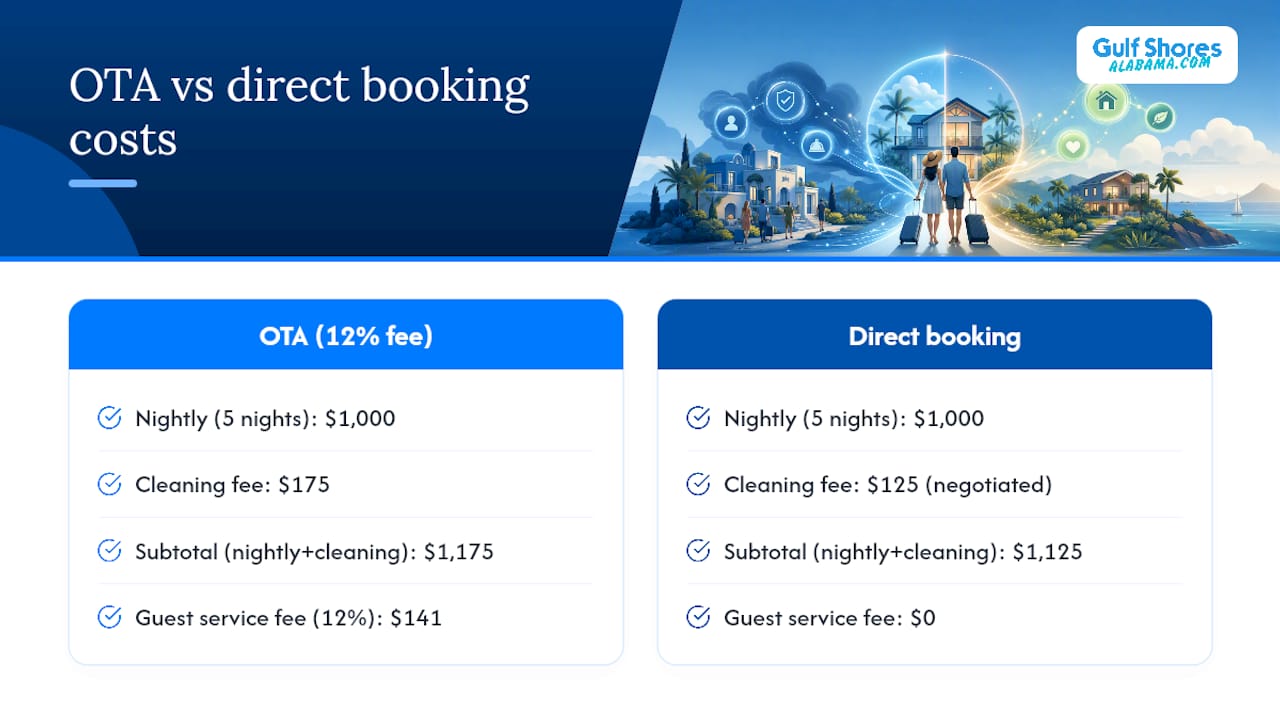
The guest service fee here is calculated on the reservation subtotal of $1,175 (nightly + cleaning), consistent with how VRBO’s sliding-scale fee works. A 12% rate sits in the middle of the 4%–20% range typical across major platforms.
Notice two things. First, the cleaning fee is lower in the direct scenario because it was negotiated down from $175 to $125 for a direct booking, a common outcome for stays of 5+ nights. Second, the tax base is slightly lower direct because the taxable subtotal is smaller without the inflated cleaning fee. The combined saving of $196 on a $1,237.50 direct booking represents roughly 14%, right in line with the ~10–15% savings range industry surveys consistently report.
To run your own numbers: take the OTA subtotal (nightly x nights + cleaning), multiply by the platform’s fee percentage, add that to the subtotal, then add taxes. Compare that total to the direct rate plus taxes only.
Why Gulfshoresalabama recommends direct booking for most U.S. trips
Having worked closely with Gulf Coast property owners and managers for years, the pattern is consistent: travelers who book direct pay less, communicate better, and leave happier. The OTA fee isn’t just a line item. It’s a layer between you and the person who actually controls your vacation experience.

On Alabama’s Gulf Coast, most properties are managed by local owners or small management companies who genuinely want repeat guests. They have flexibility that a platform algorithm doesn’t. When you call or email directly, you’re talking to someone who can approve an early check-in, adjust a rate for a longer stay, or answer a specific question about the property in real time. That direct line matters, especially when you’re traveling with a family or a large group.
The safety concern is real, and it deserves a straight answer: always use a secure payment gateway, get your rental agreement in writing, and verify the property manager’s contact information before sending any money. Direct booking done right is not riskier than an OTA booking. It’s just more personal.
No guest fees on Gulf Shores vacation rentals
Travelers who want a tested, local, no-fee booking path don’t need to hunt for it. Gulfshoresalabama lists beachfront condos, private beach homes, pet-friendly cottages, and family properties in Gulf Shores, Orange Beach, and Fort Morgan, all with direct contact to owners and managers. There are no guest service fees added by the marketplace.
Every listing on the site connects you directly to the property owner or manager, so the rate you see is the rate you negotiate. You can browse Gulf Shores vacation rentals by type, size, and location, then reach out to the host through the listing page to confirm availability, ask about direct-booking rates, or request a custom quote. Payments go through the property manager’s own secure checkout, not through a third-party platform that adds a markup.
Ready to see what’s available? Browse direct-owner listings and contact the host directly for a no-fee rate on your next Gulf Coast stay.
Sources
These are the primary sources used to build this guide. Check each platform’s official fee page before finalizing a booking, since fee structures change.
Platform fee pages update regularly. Verify the current fee percentage directly on Airbnb’s and VRBO’s help centers before you finalize any booking.
Recommended
About the Author
Joe Godar of the GulfShoresAlabama.com Editorial Team creates destination guides, vacation-planning resources, and local travel content focused on Gulf Shores, Orange Beach, and Fort Morgan, Alabama.
Our team researches Alabama Gulf Coast beaches, vacation rental trends, family activities, local attractions, restaurants, events, and direct-booking best practices. Every guide is created to help travelers plan more confidently, discover the best of the Alabama Gulf Coast, and avoid unnecessary third-party guest service fees.
GulfShoresAlabama.com is part of the Emerald Coast by Owner marketing family, connecting travelers directly with verified vacation rental hosts throughout the Gulf Coast since 2016.
This article was reviewed for accuracy and updated using local destination research and current Alabama Gulf Coast vacation rental market insights.